Do EMF Pendants Actually Work? An Honest Answer for Australians

EMF pendants are not designed to block or shield electromagnetic fields the way a bed canopy, Faraday enclosure, or device pouch does. They are designed to harmonise the field's effect on the wearer's body. Customers report improved sleep, energy and reduced head pressure, though results are subjective and individual, not clinically proven cures for illness.
Most people who type "do EMF pendants actually work" into Google have already seen the jewellery on Instagram and want a straight answer before they spend money. Fair enough. This is a category full of hype on one side and blanket dismissal on the other, and neither extreme is useful to a sceptical Australian adult trying to make a sensible decision.
At EMF Neutralizer, we sit in the middle, deliberately. We do not sell shielding fabric or paint, and we do not claim our products stop your phone from working or make a smart meter go silent. What we sell is a harmonising product, and this article explains exactly what that means, what it does not mean, and how to test the claim on yourself rather than take our word for it. For mechanism context, see how Aulterra neutralisation works. For wearable range detail, see our EMF protection jewellery guide or EMF protection hub.
Key Takeaways
- EMF pendants harmonise the biological effect of EMF exposure on the wearer. They do not block, shield, or reduce the signal strength of any device.
- Reported benefits (improved sleep, energy, head pressure, screen fatigue) are customer-reported and estimated, not medical claims or diagnoses.
- Cumulative daily exposure from multiple simultaneous sources — not any single device's regulated output — is what you actually live with in a typical Australian home.
- Based on qualitative customer outcome descriptions, we estimate a 60–85% improvement in perceived EMF-related fatigue after consistent pendant wear; individual results vary.
- In high-device environments such as home offices, users report an estimated 70–90% reduction in headache frequency; individual results vary.
- A pendant gives complete personal protection while you wear it or carry it with you; Neutralizer Discs on priority devices are worth adding when you don't have the pendant on you.
Protect your family from EMF exposure
Browse our science-backed neutralizer products.
Shop EMF ProtectionSummary Table: Harmonising vs Shielding at a Glance
- EMF Harmonising Pendant (e.g. Aulterra)
- Wear it or carry it with you; aims to harmonise the field's effect on the wearer
- Shielding (canopy / Faraday enclosure)
- Conductive enclosure physically blocks or attenuates (reduces the strength of) RF inside a defined boundary
- EMF Harmonising Pendant (e.g. Aulterra)
- No
- Shielding (canopy / Faraday enclosure)
- Yes, within the shielded area
- EMF Harmonising Pendant (e.g. Aulterra)
- Yes, moves with the wearer
- Shielding (canopy / Faraday enclosure)
- No, fixed to the enclosure
- EMF Harmonising Pendant (e.g. Aulterra)
- No
- Shielding (canopy / Faraday enclosure)
- Can interfere with signal and connectivity
- EMF Harmonising Pendant (e.g. Aulterra)
- DNA research, magnetometer and live blood tests — science and evidence
- Shielding (canopy / Faraday enclosure)
- Physics of RF attenuation (well established)
- EMF Harmonising Pendant (e.g. Aulterra)
- People wanting continuous, portable personal protection
- Shielding (canopy / Faraday enclosure)
- People wanting to reduce RF in one fixed zone, such as while sleeping
So, Do EMF Pendants Actually Work? The Short Answer
EMF pendants work as harmonising tools, not as signal blockers. If you are expecting your phone to lose bars near the pendant, it will not happen, and that expectation is where most disappointment starts. If you are expecting a calmer nervous system response to daily exposure, that is the actual design intent.
This distinction matters more than any other single fact in this article. A huge share of online scepticism about EMF pendants comes from testing them against the wrong benchmark. People wave a pendant near a Wi-Fi router expecting the signal bar to drop, it does not, and they conclude the whole category is fake.
But that is not what a harmonising pendant claims to do. The paramagnetic mineral formulation is proposed to retune incoherent fields toward a more coherent form — something magnetometer testing and frequency-signature analysis attempt to document — without blocking transmission or reducing the signal your phone needs to function. Shielding attacks amplitude inside a fixed space; harmonising works on field quality around the wearer. Physiological effects can show up quickly, but what often takes weeks is noticing the change yourself — sleep, afternoon energy, head pressure — which is why we still recommend a structured 30-day trial for those subjective outcomes, not because the effect itself is slow to begin.
We take control of your immediate environment seriously because the invisible electromagnetic burden of modern life is not going away. Routers, smart meters, laptops, phones, and televisions all run simultaneously in most Australian homes for sixteen or more hours a day. The question worth asking is not whether EMF exists around you, it clearly does, but what you choose to do about your own exposure.
What an EMF Pendant Is Actually Designed to Do
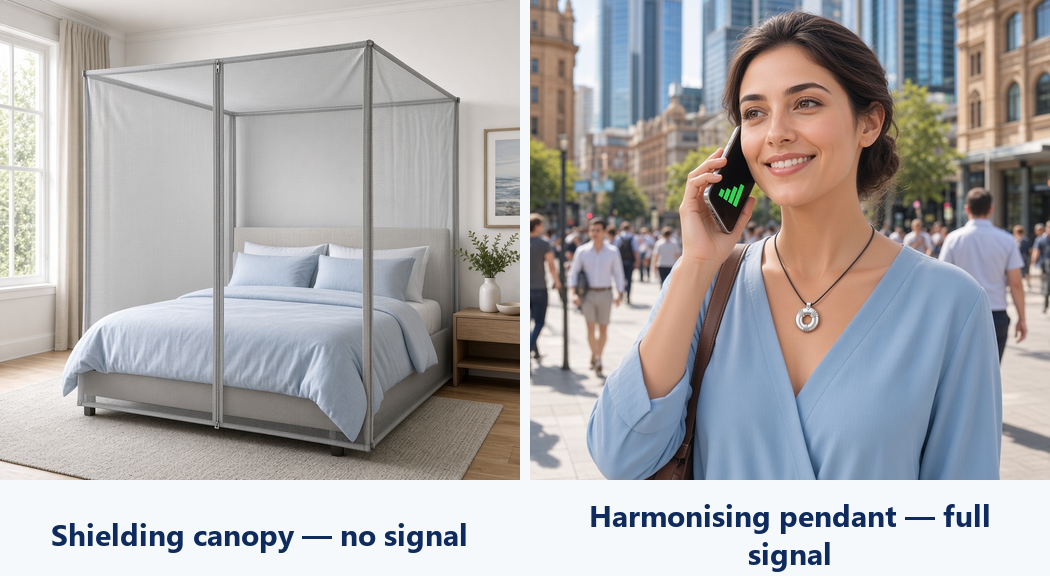
An EMF pendant is designed to harmonise and neutralise the effect of electromagnetic fields on the wearer, not to block, absorb, or shield the fields themselves. Shielding is a physics problem solved with a continuous conductive enclosure — a properly installed bed canopy, Faraday-style room, or device pouch: it attenuates — reduces the strength of — radiofrequency signal inside that boundary. Harmonising is a different physics problem — field coherence and how that field couples with biology — not a claim that nothing physical happens at all.
Aulterra pendants, including the range we stock, use a passive paramagnetic mineral formulation sealed inside the pendant — the same underlying technology across the Silver, Heart and Pillar designs. The proposed mechanism is that this shifts incoherent ambient EMF toward a more coherent form, which is why magnetometer testing shows altered frequency-signature peaks even though your phone still connects normally. That is an important, and often misunderstood, distinction.
Shielding products — properly installed bed canopies, full Faraday-style room enclosures, conductive paints and mesh systems that form a continuous boundary — work by physically attenuating radio frequency signal inside that enclosed space. We do not sell these. They have their place, particularly for someone trying to reduce RF while they sleep or in one fixed zone, but they come with real trade-offs: they can also block the mobile signal and Wi-Fi you actually want, and they only work within that specific shielded boundary.
A pendant does the opposite. It travels with you. It does not block or attenuate the signal reaching your phone, your laptop, or your smart meter — your bars stay up — but the proposed mechanism is field coherence, not signal elimination. Wear it or carry it with you, with the stated aim of supporting your biology as you move through environments you cannot control, the office, the train, the airport, the school pick-up line.
This is precisely why comparing a pendant to a shielding enclosure on the metric of "did my signal drop" is the wrong test. It will always fail that test, by design, because blocking signal was never the goal.
Why Results Feel Subjective, and What Users Actually Report
Results from EMF pendants feel subjective because the outcomes people report, better sleep, steadier energy, less head pressure, reduced screen fatigue, are internal and experiential rather than externally measurable like a signal bar. That does not make them meaningless, but it does mean two people in the same environment can report very different experiences.
We hear the same handful of themes repeatedly from customers. Sleep is the most common: people report falling asleep faster or waking less through the night once a pendant becomes part of daily wear, particularly if they also address the bedroom's device load. Afternoon energy is the second most common: people who spend eight hours surrounded by a laptop, monitor, phone, and wireless peripherals often describe a mid-afternoon fog that lifts once they add device-level protection.
Head pressure and screen fatigue come up together, usually from people in device-dense jobs who wear or carry a pendant through the workday.
The same themes show up when protection is device-level rather than worn. One customer story that stands out involved someone working long hours at a desk surrounded by a laptop, an external monitor, a mobile phone, and wireless peripherals, who had been dealing with persistent headaches and difficulty concentrating through the workday. Once Neutralizer Discs were applied directly to each device in that cluster — not a pendant — headache frequency dropped by an estimated 70–90% over four weeks (based on qualitative outcome descriptions), alongside reported improvements in concentration and a noticeable reduction in the afternoon mental fatigue that had previously set in like clockwork. Individual results vary.
Across a broader base of qualitative customer feedback, we estimate a 60–85% improvement in perceived EMF-related fatigue following consistent pendant wear. These are customer-reported and estimated figures, not clinical outcomes, and we present them that way deliberately. Anyone who tells you a pendant will produce identical, measurable results for every wearer is overselling the category.
The Cumulative-Load Problem: Why "Each Device Is Under the Limit" Misses the Point
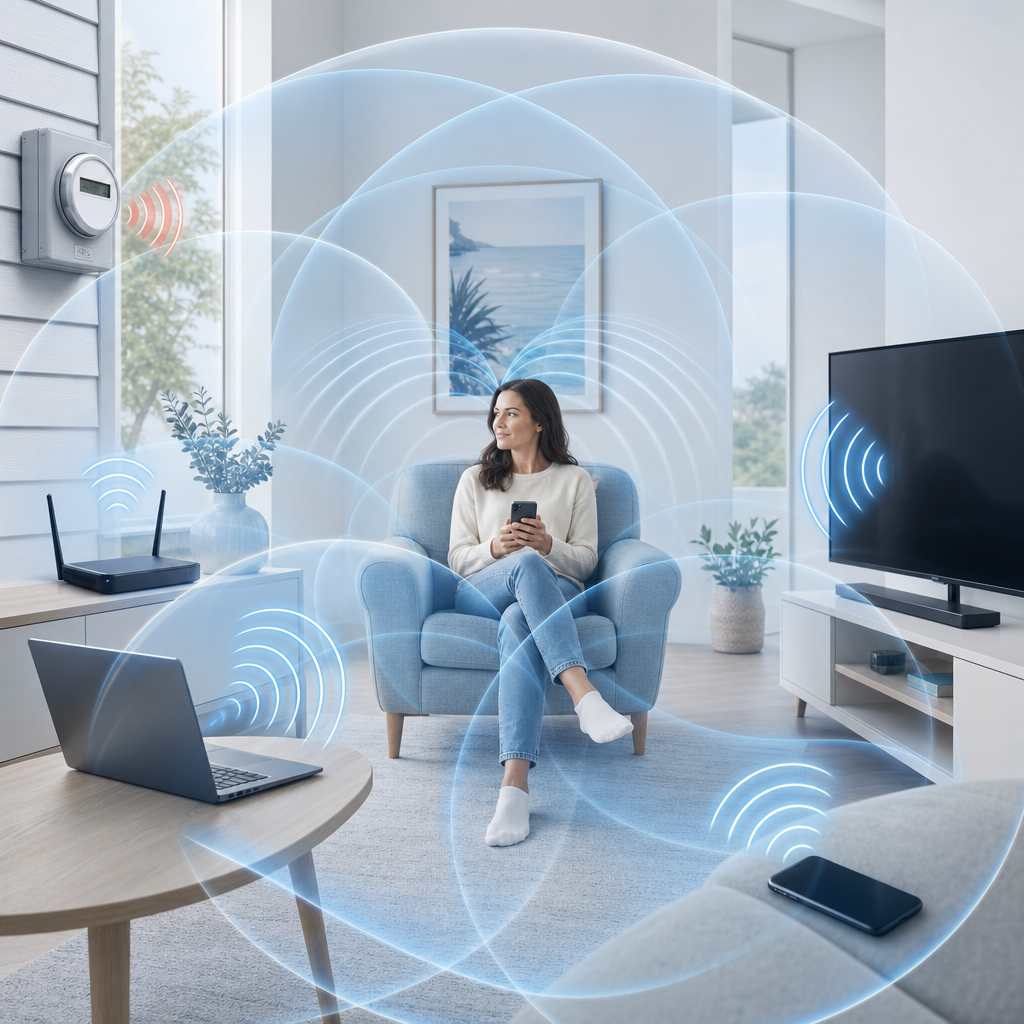
Regulatory EMF exposure limits, including those set by ARPANSA in Australia, are calculated for single-device, short-term exposure scenarios. They do not model a person surrounded by a router, a smart meter, a laptop, a phone, and a television simultaneously for sixteen hours a day. That combined, cumulative daily exposure is the picture that actually matters.
This is the non-negotiable part of our position, and we hold it without much room for compromise. Most mainstream commentary says the levels of non-ionising EMF produced by everyday consumer devices are too low to affect human health, full stop, no protective measures required. We think that framing is technically true for any one device tested in isolation, and largely irrelevant to how people actually live.
A regulatory threshold tells you that a single phone, tested on its own, sits under a defined safety limit. It says nothing about what happens when that phone sits in your pocket next to a smartwatch, in a room with a Wi-Fi router two metres away, while a smart meter on the wall outside cycles constantly, and a laptop runs on your desk. Nobody's exposure happens one device at a time. It happens all at once, all day, for years.
We worked directly with a customer who had just moved into a new apartment and started experiencing headaches, vertigo, fatigue, low mood, ringing ears, and a scattered, hard-to-focus feeling she described as similar to extreme ADHD. There was an audible hum in the wall shared with her neighbour, and a large transformer box sitting directly outside her bedroom window. Sleeping in that room felt unsettling even before she understood why.
We recommended a Whole House USB alongside Neutralizer Discs on the main sources in her home. Her mother ended up buying the plug-in unit and a pendant for her. She told us she was genuinely sceptical that something this simple could help, and after just one night using the plug-in and wearing the pendant, she felt refreshed for the first time in weeks. She went on to order discs for the microwave, the Wi-Fi router, smart meter and other hotspots around the apartment, on the reasoning that a long floor plan meant extra coverage was worthwhile even with the whole-house unit running. Individual results vary.
That is the cumulative-load argument in practice. No single appliance in that apartment was flagged as unsafe by any regulator. The combined environment was still doing something she could feel.
How to Test an EMF Pendant for Yourself: A 30-Day Self-Observation Approach
The most reliable way to judge whether an EMF pendant works for you is a structured 30-day self-observation trial, tracking sleep quality, afternoon energy, and headache frequency before and after you start wearing or carrying it with you. This turns a subjective claim into a personal data set you control, rather than something you have to take on faith.
Start with a baseline week before the pendant arrives. Each night, jot down roughly how long it took to fall asleep and how many times you woke. Each afternoon around 2 to 4pm, rate your energy from one to ten. Note any headaches, when they started, and roughly how intense they were. Keep it simple, a notes app or a scrap of paper is fine, you are not writing a lab report.
Once your pendant arrives, wear it or carry it with you consistently every day for the following four weeks. Keep the same nightly and afternoon notes going. Pay particular attention to your heaviest device days, the days you are on video calls back-to-back, or working from a laptop with a phone, tablet, and monitor all running at once. These device-dense days are where a harmonising product has the clearest theoretical role to play, and where differences, if they exist for you, tend to show up first.
At the end of four weeks, compare the two data sets honestly. Look for trend, not perfection. A single bad night does not disprove anything, and a single great night does not prove anything either. What you are looking for is a pattern across the full 30 days: fewer restless nights, a flatter afternoon energy curve, fewer or milder headaches on device-heavy days.
If you already experience symptoms you recognise as EMF-related — headaches tied to device use, unusual fatigue after long screen sessions, a wired-but-tired feeling in the evening — this kind of structured comparison is far more useful than a single anecdote from a stranger online, ours included.
Choosing From the Aulterra Range for Layered EMF Protection
The right Aulterra pendant is a matter of materials, styling and routine — the Silver Energy Pendant, Heart Energy Pendant and Pillar Energy Pendant use the same paramagnetic mineral technology with equal protection strength. The Vitality Wristband suits people who prefer not to wear jewellery around the neck. While you wear it or carry it with you, protection is complete; Neutralizer Discs on priority devices are worth adding when you don't have the pendant on you. See our jewellery guide for a full range comparison.
The Silver Energy Pendant sits at the top of the range in materials and presence — hand-made sterling silver for adult wearers who want a premium piece. The Heart Energy Pendant is the lightest format and suits anyone who wants jewellery-first styling. The Pillar Energy Pendant is a slim vertical bar on a black cord — unisex and understated, a straightforward option for everyday wear.
The Vitality Wristband sits at a lower price point and suits people who want the same underlying technology without wearing a necklace — particularly useful for anyone whose workplace has a strict no-jewellery policy or who simply prefers a wrist-worn product.
One customer story that stands out is Karin, who has severe, lifelong allergies that are noticeably worsened by device use, to the point that phone and laptop use trigger her mould-related allergic response and she is legally recognised as disabled because of it. For years, her way of managing this was self-isolation, living remotely away from built-up areas just to reduce her exposure.
We started her with a Neutralizer Disc on her phone. The difference was immediate enough that when the disc later fell off without her noticing, she became ill again quickly, which told us plainly how much that single disc had been doing. She later added a Pillar Energy Pendant, and she describes the change as life-changing: she can now drive through a city, something that used to be intolerable for her, and she has managed an international flight to see family, wearing the Pillar the entire way, confident it gave her the coverage she needed. Individual results vary.
For most people, the sensible starting point is a pendant worn or carried with you through the day, plus Neutralizer Discs on priority devices. While the pendant is with you, personal coverage is complete; when it is not, the discs cover the devices you still use. That layered EMF protection pattern is how we most often see people set things up.
What Years of Fitting These Products Has Actually Taught Us
The clearest thing years of doing this work has taught us is that self-testing beats persuasion every time. What follows are two customers who set out to verify the claim for themselves — not on our prompting, but because they wanted evidence they could trust.
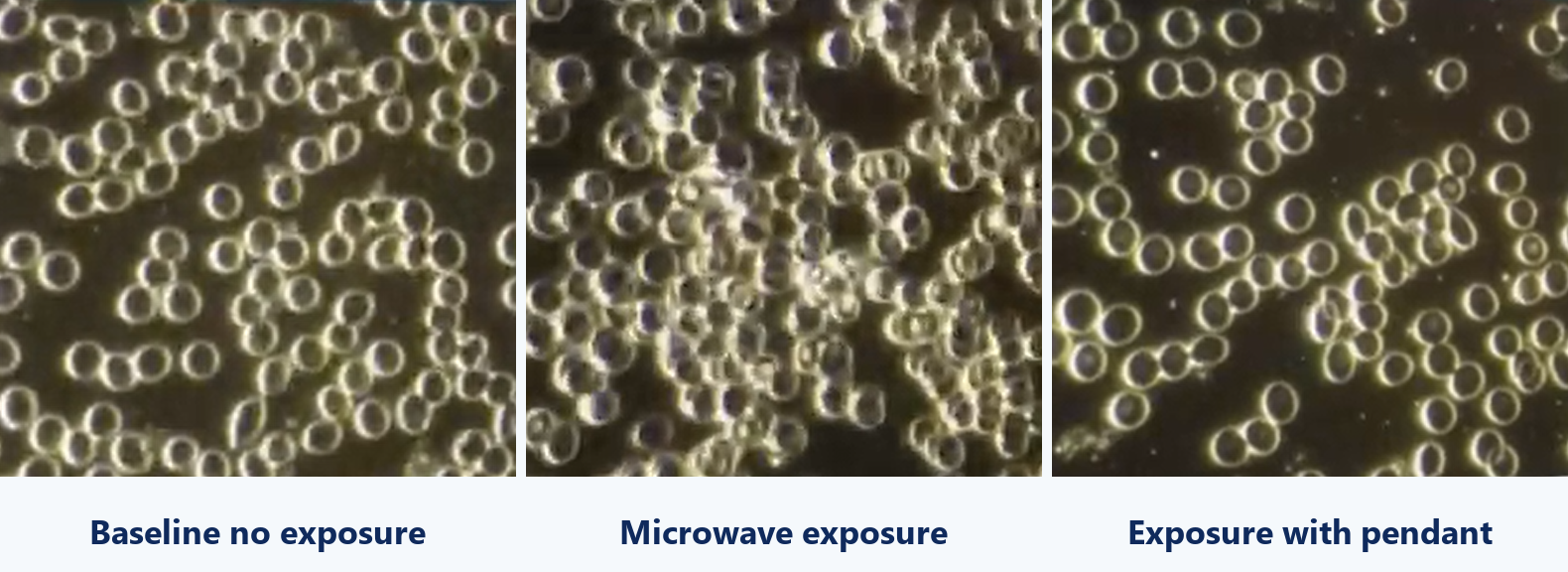
One customer, Devin, who had purchased an Aulterra pendant, asked us directly how she could verify for herself whether it was doing anything. We suggested live blood analysis using dark field microscopy and talked her through the process. She paid for her own independent testing and filmed the results, which she later shared publicly. Her baseline blood sample showed cells moving freely with no clumping. After four minutes standing near an operating microwave oven, her blood cells showed visible aggregation and slower movement. Wearing the pendant during a repeat of the same microwave exposure, she described the movement as noticeably less clumped and more free-flowing than the unprotected test, though not fully back to baseline, partly because the pendant had only been on for a short time before exposure started. She told us afterwards that it was the first time she had actually witnessed a physical difference rather than just reading about one. That is one informal self-test, not a clinical trial; individual results vary.
We have also seen the products taken seriously by people whose profession depends on evidence. Peter Mitchell, Principal Physiotherapist and owner of Nerang Physiotherapy on the Gold Coast, started using Aulterra devices across his own laptops, phones, and his children's laptops, along with Whole House USB units at home and at the clinic. He ran his own kinesiology-based testing over several months and reported finding the products effective at reducing stress responses linked to radiofrequency exposure from mobile devices, to the point that he became a reseller and now sells them directly to his clinic's clients.
Our honest take, after fitting these products across homes, offices, and clinics for years, is that scepticism is the right starting position. We would rather a customer run a proper 30-day trial and decide for themselves than take a marketing claim on faith. Our strongest advocates usually fall into one of two groups. Some already feel their symptoms clearly and notice relief when they try the products — not because they were persuaded, but because they sensed the difference. Others verify the claim first, through a structured trial, live blood analysis, or kinesiology, and trust the products once the results confirm it.
References
These references establish regulatory context. They do not endorse EMF Neutralizer products.
- Australian Radiation Protection and Nuclear Safety Agency, Understanding radiation.
- Australian Communications and Media Authority, EME, 5G and you.
- World Health Organization, Radiation: Electromagnetic fields.
If you have read this far and you are still on the fence, that is a reasonable place to be. Browse the wearable EMF protection collection, pick the pendant or wristband that matches how you actually spend your day, and add a Neutralizer Disc on your phone for when you are not wearing or carrying it. Commit to a full month of normal life wearing or carrying it with you, notes and all, before you decide whether it belongs in your routine. We cannot tell you whether it will work for you — a month of your own notes is the honest answer.
Stay informed on EMF wellness
Get practical tips and product updates in your inbox.
Frequently asked questions
Do EMF pendants block radiation from my phone?
No. EMF pendants are not shielding products and will not reduce your phone's signal strength or block radiofrequency emissions. They are designed to harmonise ambient EMF through a paramagnetic mineral formulation proposed to shift incoherent fields toward a more coherent form — field quality, not blocked transmission — which is a different mechanism entirely from physical shielding.
Do EMF pendants actually work?
Yes — as harmonising tools on the wearer, not as signal blockers. Aulterra pendants use a passive paramagnetic mineral formulation sealed inside the pendant — not batteries or electronics — proposed to shift incoherent electromagnetic fields toward a more coherent form, documented in magnetometer and frequency-signature testing on our science and evidence page. That is a different physics from shielding: field quality, not blocked transmission. See how Aulterra neutralisation works for the full mechanism.
Is there scientific proof that EMF pendants work?
There is no peer-reviewed clinical trial proving EMF pendants work for every wearer, and we do not claim otherwise. Documented research on the paramagnetic compound — including peer-reviewed DNA work — is on our science and evidence and research pages. Live blood analysis demonstrations filmed at Aulterra are on our science and evidence page. Independent customer tests, including kinesiology and live blood analysis, are on our testimonials page. These are demonstrations and informal self-tests, not clinical trials. EMF Neutralizer makes no medical claims; individual results vary.
What's the difference between EMF harmonising and EMF shielding?
Shielding uses conductive materials in a continuous enclosure — a properly installed bed canopy, Faraday-style room, or device pouch — to physically attenuate radiofrequency signal inside that boundary. Your phone may lose bars; protection stops at the enclosure. Harmonising does not block transmission. A pendant's paramagnetic mineral formulation is proposed to shift incoherent fields toward a more coherent form, documented in magnetometer testing on our science and evidence page. You wear or carry it with you — full signal, protection that moves with you.
How long does it take to notice a difference wearing an EMF pendant?
Some people notice a difference straight away. Most customer reports describe changes emerging over two to four weeks of wearing or carrying a pendant consistently, particularly around sleep and afternoon energy. We still recommend a structured 30-day self-observation trial so you can see the full pattern, not judge it on a single day.
Can I wear an EMF pendant with a phone neutralizer disc at the same time?
Yes. While you wear it or carry it with you, it gives complete personal protection. Neutralizer Discs on your phone, laptop and router are a practical add-on for the hours you are not wearing it — see our pendant vs wristband vs disc comparison.

Richard Kent
Science-backed EMF wellness education from the EMF Neutralizer team.
Related articles

Best EMF Protection Sticker for Your Phone in Australia: An Honest Review and Comparison
The best 'EMF protection sticker' for an Australian phone user is the Aulterra Neutralizer Discs 3-Pack — small adhesive discs applied one per device, starting…
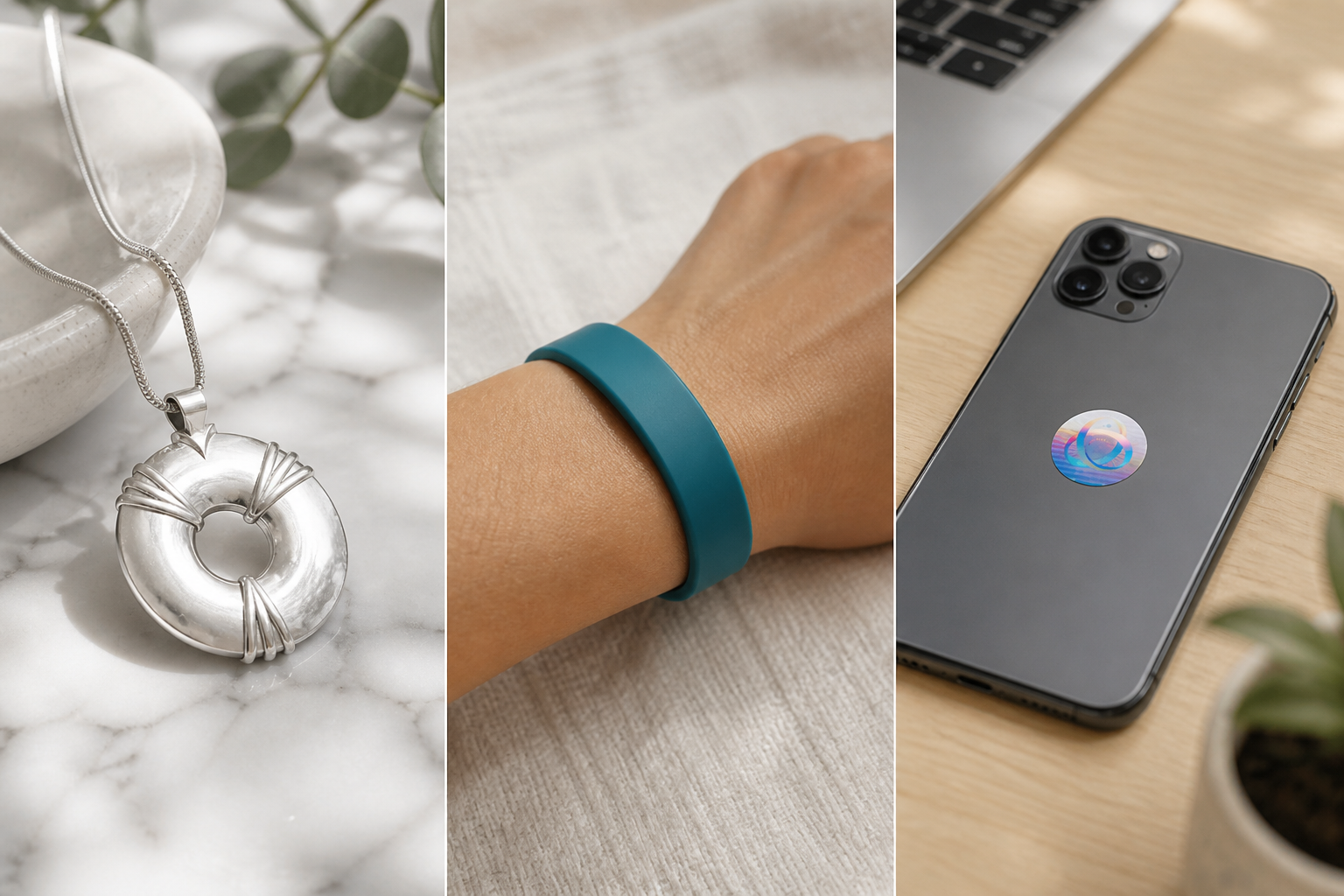
Comparison page: pendant vs wristband vs disc for EMF protection
A pendant is the strongest all-purpose choice for personal EMF protection, while a wristband suits people who prefer a wearable away from the neck. A disc is di…
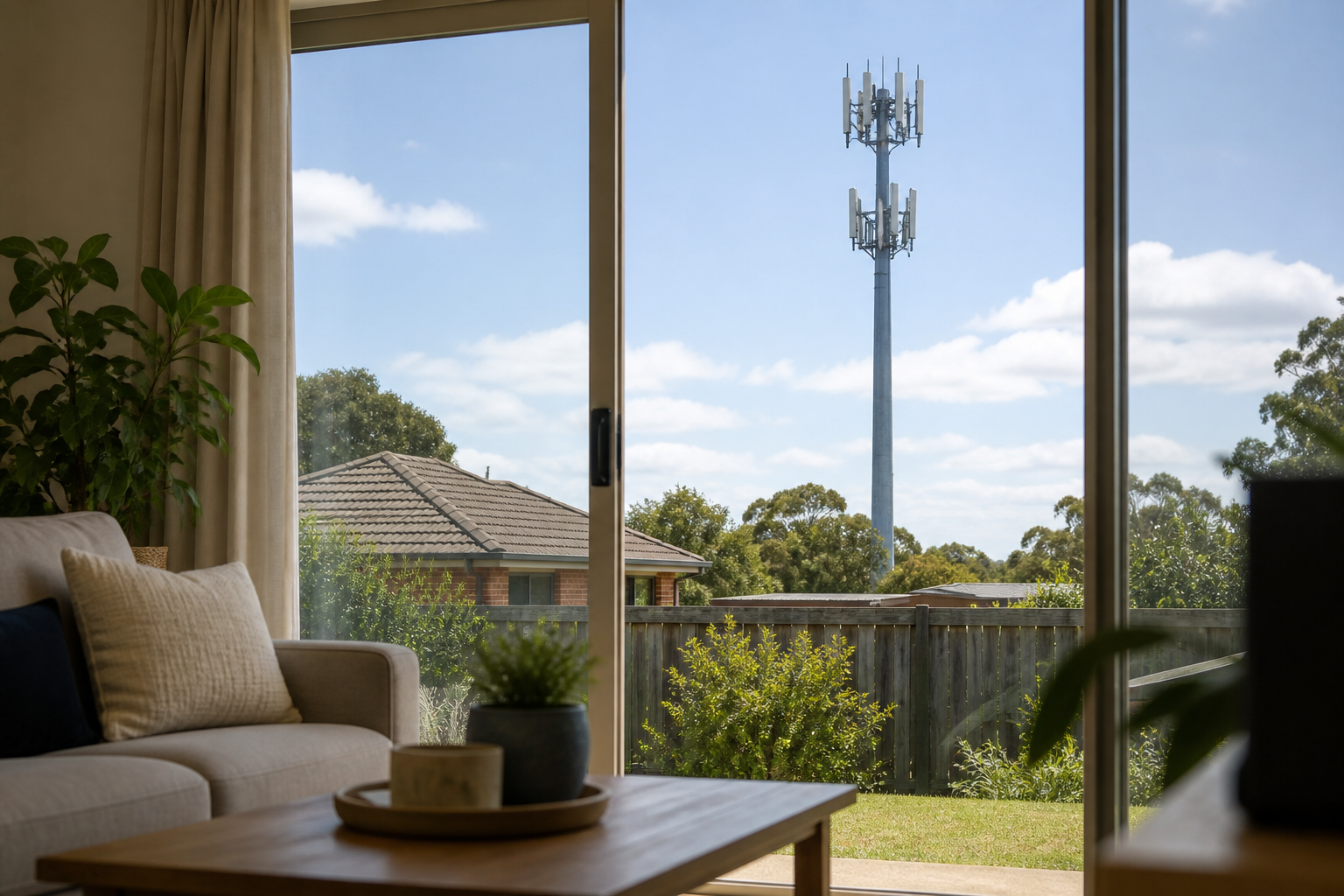
5G Health Concerns Australia
Australian health authorities say 5G radiofrequency exposure below national limits has not been shown to cause adverse health effects. However, that does not ma…