EMF protection pendant buying guide for Australians
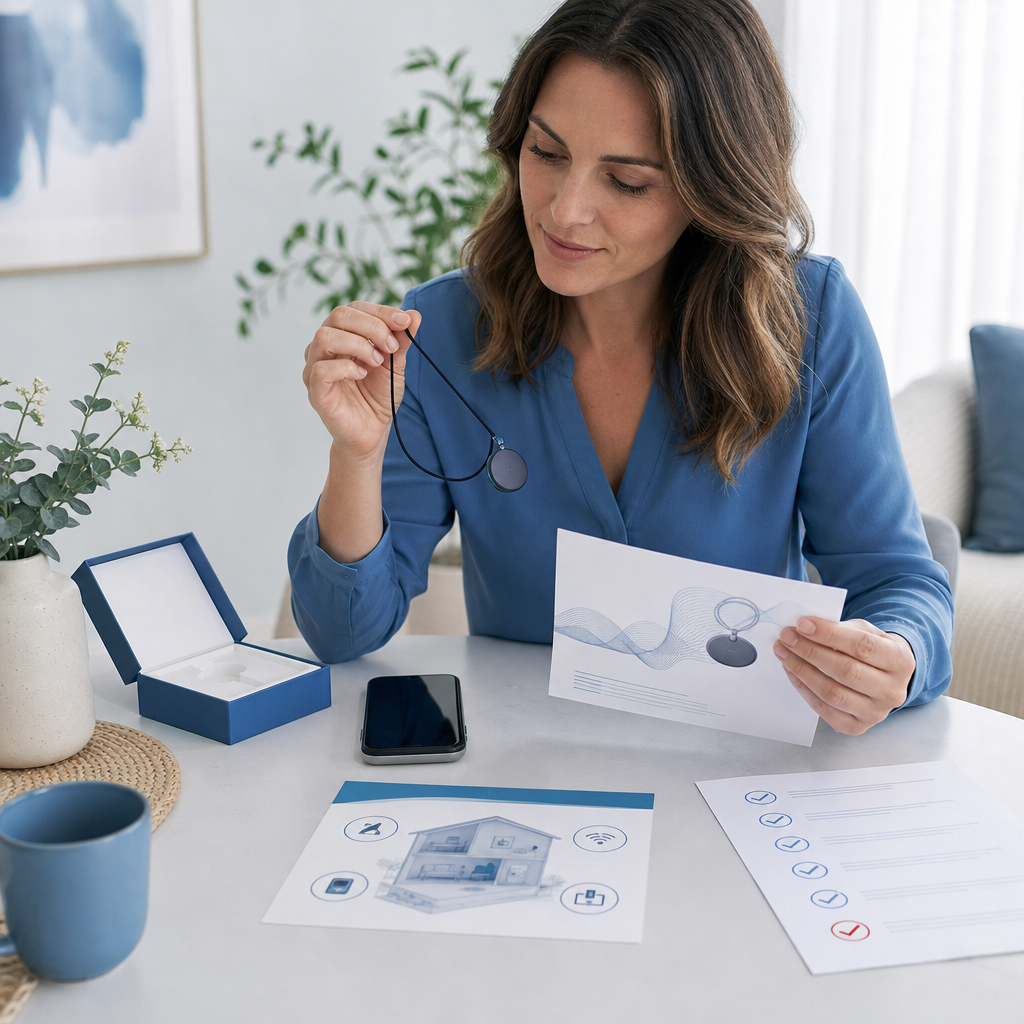
An EMF protection pendant should be assessed by its stated purpose, evidence, seller transparency, construction, coverage and returns policy. Choose a pendant designed for continuous personal use so protection stays with you through normal phone, laptop and wireless use. That portability is why many buyers choose one: they want support through everyday technology, not a life reorganised around avoiding EMF. Layer in device-specific or home products where they add targeted coverage for the sources you use most.
Australians face a crowded market of pendants, necklaces, chips and stickers making very different claims. Some sellers explain what their products are intended to do. Others rely on vague scientific language, generic laboratory logos or fear-based marketing.
This guide explains how to separate credible products from weak claims. It also shows where a pendant fits within layered EMF protection for your home, workplace and travel. For Aulterra range comparison and care basics, see our EMF protection pendant necklace Australia guide. To compare pendant, wristband and disc formats side by side, see our pendant vs wristband vs disc guide. After purchase, follow the manufacturer's wearing and care instructions supplied with the product.
The products discussed here are environmental wellbeing products. Claims in this guide describe general wellbeing support based on documented customer experiences and published research—not therapeutic outcomes regulated by the TGA in Australia, and not a substitute for medical advice or treatment.
Key takeaways
- Decide whether you want shielding, distance, source reduction or a product intended to neutralise your immediate environment.
- A pendant is for portable support through normal device use; add discs or home products where they cover fixed sources you rely on most.
- Ask for evidence linked to the exact product, not research about unrelated materials or EMF in general.
- Check the Australian seller's identity, returns terms, warranty and claims before purchasing.
- Consider your cumulative daily exposure across home, work, commuting and sleep, rather than focusing on one device.
- Personal reports can guide questions, but they are not substitutes for controlled clinical evidence.
Protect your family from EMF exposure
Browse our science-backed neutralizer products.
Shop EMF ProtectionSummary table
- Primary role
- Portable personal coverage as described by the manufacturer
- Best suited to
- People moving between home, work and public environments
- Main limitation
- Product mechanisms and evidence vary substantially
- Primary role
- Targets a phone, laptop, router or other identified source
- Best suited to
- Concentrated device use
- Main limitation
- Only addresses the device to which it is applied
- Primary role
- Broader environmental approach
- Best suited to
- Homes containing multiple fixed and wireless sources
- Main limitation
- Coverage depends on product design and property layout
- Primary role
- Reduces avoidable proximity or active transmission
- Best suited to
- Phones, routers, laptops and bedrooms
- Main limitation
- Requires consistent habits
- Primary role
- Reduces selected wireless sources
- Best suited to
- Fixed workstations and home networks
- Main limitation
- Not practical for every household or device
What is an EMF protection pendant, and what should it actually do?
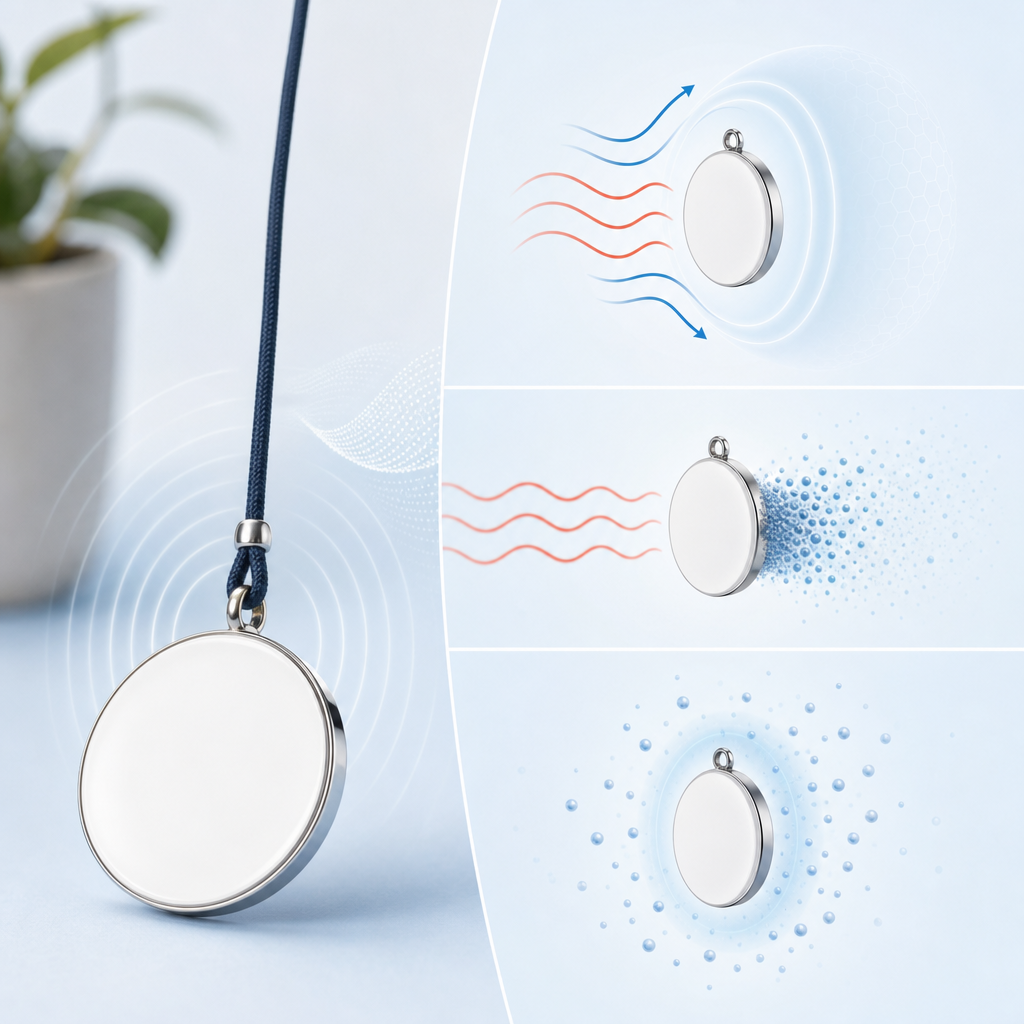
An EMF protection pendant is a wearable product marketed to provide personal support around electromagnetic fields. Depending on its design, it may claim to shield, absorb, harmonise or neutralise EMF. These terms are not interchangeable. Buyers should require a clear explanation of the intended mechanism, coverage and realistic product limitations.
A pendant is attractive because it remains with you. A home product cannot follow you into an office, shopping centre, airport or vehicle. Device attachments also remain behind when you change devices. A wearable product is intended to provide continuity across these changing environments.
That portability is the pendant's main practical advantage—the same technology can stay with you while environments change.
Neutralising is different from blocking
A product described as shielding should demonstrate that it reduces field strength or power density under defined test conditions. That can usually be assessed with appropriate instruments, although test setup matters.
A product described as neutralising may not claim to reduce a conventional meter reading. Its stated purpose could instead concern the biological interaction or organisation of the field. If a seller uses this language, ask how that outcome was tested and whether the method is accepted for the claim being made.
Be cautious when a seller shifts between shielding and neutralising language. If the product supposedly blocks radiation on one page but does not alter measured fields on another, the explanation is incomplete.
Pendants are not medical treatment
Do not use a pendant to diagnose, treat or delay care for headaches, vertigo, sleep problems, allergic reactions or other symptoms. Those symptoms can have many causes. Persistent or severe symptoms require assessment by a qualified health professional.
A credible seller should be able to discuss customer experiences without presenting them as guaranteed medical outcomes. This distinction protects the buyer and keeps the product claim within realistic limits.
How should Australians assess their actual EMF exposure?
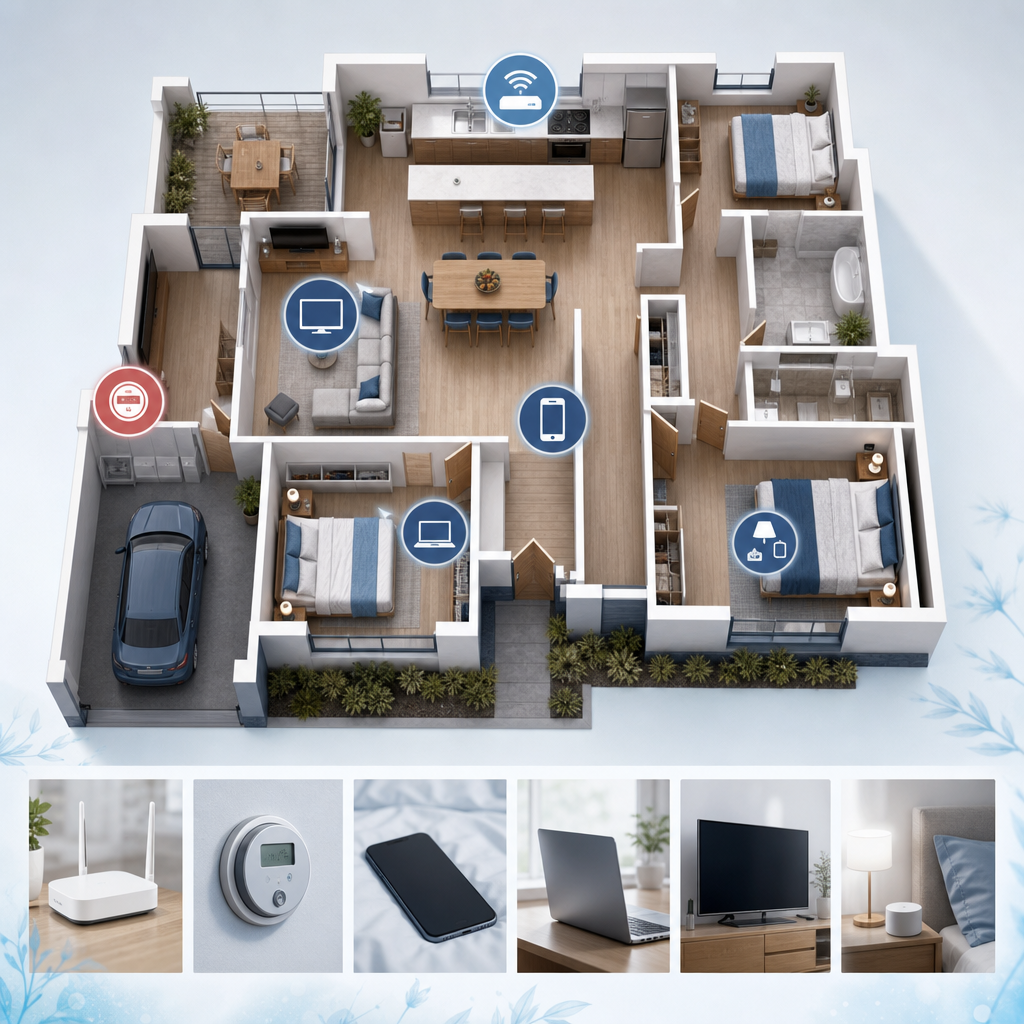
Assess exposure by identifying sources, proximity, duration and unnecessary transmission. Start with devices used close to the body, equipment operating beside a desk, wireless infrastructure near sleeping areas and appliances running for long periods. This practical audit is more useful than treating every source as equally important or relying on one meter reading.
Common household and workplace sources include mobile phones, Wi-Fi routers, Bluetooth peripherals, smart meters, cordless phone bases, laptops, monitors and electrical wiring. These sources do not all produce the same frequencies or exposure patterns.
The Australian Radiation Protection and Nuclear Safety Agency (ARPANSA) explains the distinction between ionising and non-ionising radiation and publishes Australia's radiofrequency exposure standard. That framework matters because consumer wireless devices use non-ionising radiofrequency energy, not the ionising radiation associated with X-rays.
Our position goes beyond checking whether each device complies in isolation. Modern exposure is cumulative in the ordinary sense that people move through overlapping fields across the day. A compliant phone, router and laptop can still create an invisible electromagnetic burden that some people prefer to address proactively.
This is not a claim that exposure simply adds together as one universal dose. Frequencies, field types, distance and operating conditions differ. It is a practical observation that real environments contain multiple simultaneous sources, while buyers often assess only one device. For how WHO and ARPANSA exposure limits relate to that everyday picture in Australia, see our dedicated guide.
Conduct a room-by-room audit
For each room, record:
- What transmits continuously or intermittently
- How close the source is to where people sit or sleep
- Whether it needs to remain active
- Whether a wired connection is realistic
- Whether the source can be moved further away
- Whether a device-specific or room-level product would be more relevant
Pay particular attention to bedside tables and home offices. A phone under a pillow, wireless charging equipment beside the bed and a router behind the bedhead create avoidable proximity. At a desk, the concentration of devices can matter more than any single item.
A meter can help locate sources, but it cannot diagnose symptoms or prove that a pendant works biologically. Consumer meters also vary by frequency range, sensitivity and measurement method. Use measurements to improve your source map, not to create false precision. See our guide to testing EMF levels at home in Australia for practical limits.
How do you choose a credible EMF protection pendant?
Choose a pendant by examining the exact claim, product-specific evidence, manufacturing transparency, wearing instructions, durability and buyer protections. Reject products that offer only generic EMF research, unexplained scientific terminology or guaranteed health outcomes. A trustworthy seller should state what the pendant is intended to do and what its evidence cannot establish.
Define the job before comparing products
Start with your use case. A commuter wearing a pendant through offices and public transport has different needs from someone mainly concerned about a home office. Consider whether you need:
- Continuous personal use across changing locations
- Support during travel or time in built-up areas
- A complement to device-specific products
- A non-electronic product requiring no charging
- A pendant that can be worn comfortably for extended periods
If the concern stays with one fixed phone or laptop, a disc on that device may be enough. If exposure follows you through the day, a pendant keeps the same compound technology with you.
Demand product-specific evidence
The evidence should relate to the product being sold. Research showing that a material has an electrical property does not automatically prove that a finished pendant provides a meaningful effect when worn.
Ask these questions:
- Was the exact pendant range tested?
- Who performed the test?
- Was there a comparison or control condition?
- What equipment and endpoint were used?
- Can the full method and result be reviewed?
- Has the result been independently replicated?
- Does the evidence support the wording used in the advertisement?
Laboratory terminology is not enough. A microscopy image, thermal image or instrument screenshot can look persuasive while omitting controls, calibration and interpretation.
Check construction and wearing requirements
A daily pendant needs to survive sweat, movement, commuting and routine handling. Check the pendant material, chain or cord, clasp, water exposure instructions and replacement terms. Confirm whether it must touch the skin, remain outside clothing or be worn at a specified height.
Also ask whether the product has an expected service life. If the seller says it never expires, ask what supports that claim. If it will expire and require replacement, the seller should explain why and when.
Avoid borrowed authority
Logos and terms such as quantum, scalar, frequency, biofield and resonance do not establish performance by themselves. Nor does a reference to government exposure standards prove that a pendant offers protection.
A sound product page separates three things: what is known about EMF, what testing was performed on the product, and what customers have reported. When those categories are blurred, comparison becomes difficult. See independent scientific studies on EMF neutralisation and EMF protection brand trust signals for examples of what to look for.
What evidence can establish that an EMF pendant works?
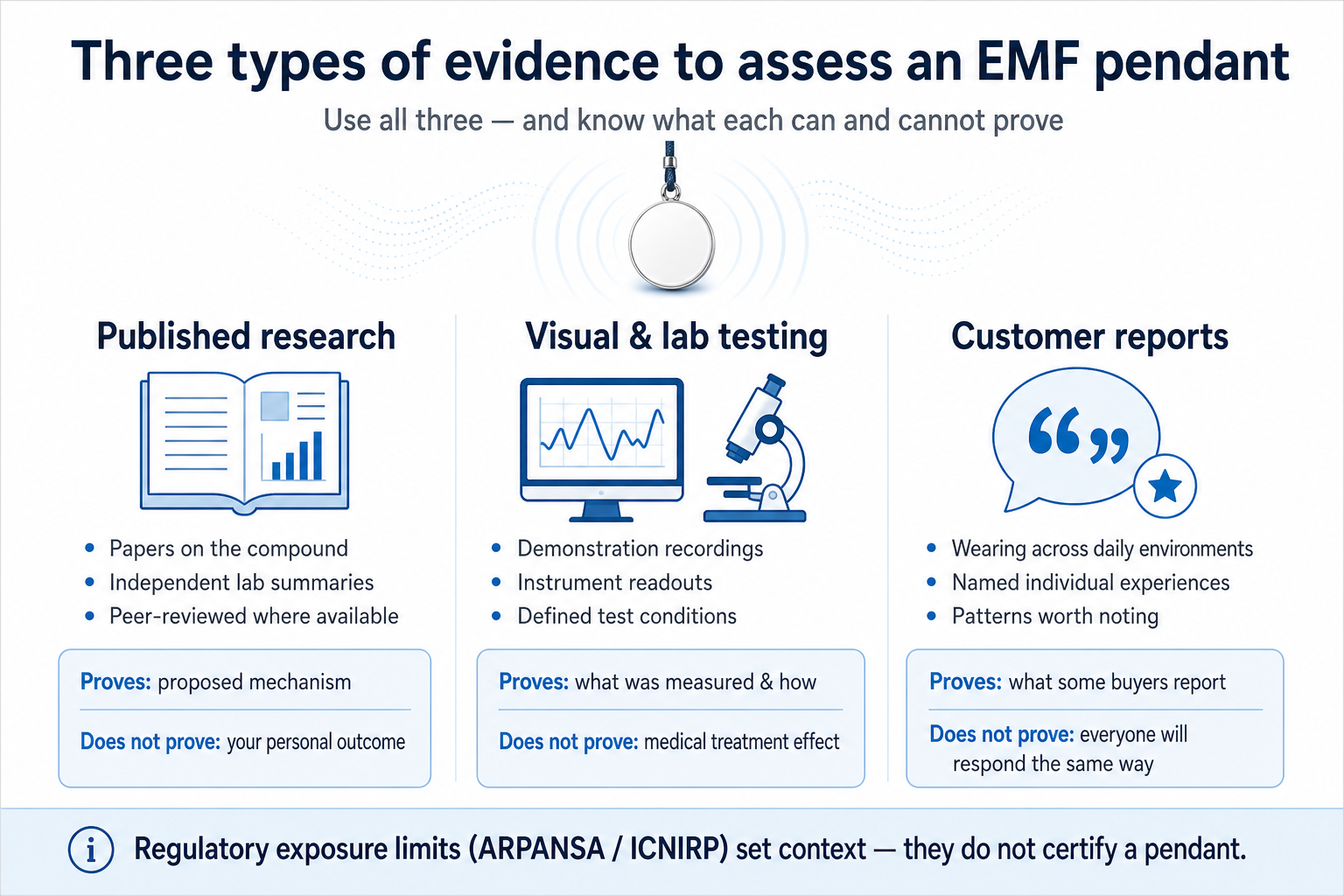
No single test answers every question about an EMF pendant. Instrument testing can assess shielding claims, while biological claims require suitable biological methods and controls. Customer experiences may identify patterns worth investigating, but they cannot exclude placebo effects, environmental changes, measurement error or unrelated causes. Evidence should match the precise advertised outcome.
International and Australian exposure guidance focuses on established effects and defined exposure limits. The ICNIRP radiofrequency guidelines and ARPANSA's Australian standard provide useful regulatory context, but they do not certify consumer pendants.
When a pendant contains a documented mineral compound rather than an unexplained insert, the more relevant evidence is research on that compound and how it was tested. Genuine Aulterra pendants use the same paramagnetic mineral technology found in Neutralizer Discs and other Aulterra formats—the mechanism is shared even when the product form changes. Published papers, study summaries and downloadable research are collected in our research library. Live demonstrations, instrument graphs and visual test recordings are on EMF Testing & Visual Evidence. Review those sources when assessing whether the seller's mechanism claim is supported beyond marketing language. They document work on the compound and testing methods; they do not by themselves guarantee a specific outcome for every wearer. For a longer explanation of the technology, see what Aulterra EMF protection technology is.
Likewise, a seller should not imply endorsement merely because a product was tested near equipment that meets a recognised standard.
What customer reports can tell us
For a pendant, credible customer evidence should describe wearing the necklace across everyday situations—not overall satisfaction figures that combine discs, whole-home products and other wearables.
EMF Neutralizer's broader qualitative records span discs, whole-home USB and wearables combined. They include an estimated 60-85% improvement in perceived EMF-related fatigue in residential settings and an estimated 70-90% reduction in headache frequency in some high-device workplace reports. Those ranges reflect mixed product use and self-reported outcomes. They are not randomised trial results and do not establish medical efficacy.
One documented workplace case involved Neutralizer Discs on a laptop, external monitor, mobile and wireless peripherals. Over four weeks, the user estimated that headache frequency fell by 70-90% and reported better concentration. That is one layered example. Aulterra pendants use the same paramagnetic mineral technology, and many buyers wear a necklace at work rather than treating every device separately. The reviews below describe similar daily and workplace experiences from pendant wear alone.
Pendant-specific reports are usually individual accounts: tolerance during travel and time in built-up areas, headaches when not wearing, or feeling more settled around everyday wireless use. The examples below come from approved reviews of Aulterra pendants worn on their own. They show the kind of detail worth looking for. Individual results vary, and other factors can also affect how someone feels day to day.
Immediately after wearing your Pillar pendant I felt more calm and relaxed, especially at work with several EMF sources in my office.
— Glenn M
I have been wearing this necklace every day for one week. I was sensitive to EMF at work. Now I feel amazing — I can breathe easily and enjoy nature's energy again.
— Danielle Szostak
I have worn my pendant for years and can tell the difference. If I do not wear mine I get a headache within hours.
— Arla Henry
More pendant and product reviews are on our testimonials page.
A customer-led microscopy test (pendant)
A customer named Devin arranged and paid for live blood analysis using dark-field microscopy. Her recorded observations compared baseline blood, exposure near an operating microwave for four minutes, and a further exposure while wearing a pendant.
She and the practitioner observed more aggregation and slower movement after the microwave exposure. During the pendant condition, they described the cells as more free-moving and less clumped than in the preceding exposure. The recording is available on our testimonials page.
This is an individual demonstration, not a blinded clinical study. Live blood analysis is not an accepted standalone method for diagnosing illness or proving that an EMF product prevents harm. Nevertheless, the recording gives buyers a concrete before-and-after view of what one wearer observed during exposure. We share it because the customer independently sought a way to examine her experience.
How should a pendant fit into layered EMF protection?
A pendant should sit within a layered plan that matches how you actually live. Wearable coverage is the main reason many buyers choose a pendant: it stays with you when locations change, so you do not have to structure your day around avoiding phones, laptops or public wireless. Device attachments and home products can add targeted coverage for fixed sources you use most.
Some buyers also make simple placement or settings changes where they are easy—moving a router further from a bed, using speaker mode on long calls, or turning off wireless functions they do not use. These are optional complements, not the reason a pendant exists.
Then match products to the remaining pattern. Compare wearable formats and device options before committing to one approach:
- Use a wearable EMF pendant for personal continuity across environments.
- Use Neutralizer Discs for frequently handled or nearby electronics.
- Consider Whole House USB where many fixed sources remain active.
- Reassess the setup after moving home, changing routers or rebuilding a workspace.
One customer with severe allergies reported that phone and laptop use aggravated her symptoms. She initially applied a neutraliser disc to her phone and later wore a Pillar pendant. She told us the products helped her tolerate built-up areas and complete international travel that she had previously found difficult.
Her experience was personally significant, but it does not prove that EMF caused her allergic symptoms or that another person will respond similarly. Severe allergies and disability require appropriate medical support. The relevant buying insight is that once she added a pendant, she had portable coverage for built-up areas and travel—not only protection tied to one phone.
Layered EMF protection should support your biology without creating anxiety. The aim is to take control of your immediate environment, not to monitor every appliance obsessively.
What Australian consumer protections and warning signs matter?
Australian buyers should verify the seller's identity, total price, delivery terms, warranty, returns process and evidence behind health-related claims. Consumer guarantees may apply regardless of a store's written warranty. Products should match their description, be fit for disclosed purposes and meet the quality expectations established under Australian Consumer Law.
The Australian Competition and Consumer Commission explains that consumer guarantees apply to products and services bought by Australian consumers. A seller cannot remove those statutory rights merely by displaying a restrictive returns policy.
Before ordering, save a copy of the product page and advertised claims. Check whether the business provides an Australian address, contact details and clear pricing that includes or explains GST. If buying from an overseas marketplace, enforcing a remedy may be harder.
Watch for these warning signs:
- Guaranteed cures or promises to prevent named diseases
- Claims that every user will feel an immediate effect
- Countdown timers that continually reset
- Testing reports that do not identify the actual product
- Scientific diagrams without methods or sources
- Claims of government approval where none is documented
- No clear returns process or seller identity
- Testimonials presented as clinical proof
The Therapeutic Goods Administration regulates advertising for therapeutic goods in Australia. Whether a product falls within that framework depends on its presentation, intended purpose and claims. Sellers making therapeutic claims should understand those obligations rather than assuming a wellness label removes them.
The buying mistake most guides overlook
The biggest mistake is choosing a pendant before mapping the exposure pattern it is supposed to address. Buyers often search for the strongest product without defining whether their concern is a phone, workstation, bedroom or changing public environment. Product selection improves when coverage follows the person's routine instead of marketing language.
Our view is that a pendant is not a talisman and should not be marketed as one. Its strongest practical case is continuity. It stays with the wearer when the environment changes.
That leads to a simple coverage test. Write down where you spend your day, what sources remain close and which controls are available. If the main concern sits at one fixed workstation, discs on those devices may be enough. If it follows you between home, transport, work and travel, a pendant is often the more natural starting point.
This also explains why a low meter reading does not settle every buying question. A conventional meter may show whether field strength changes, but a neutralising product may make a different claim. The burden then falls on the seller to provide evidence appropriate to that mechanism, not to dismiss measurement altogether.
At EMF Neutralizer, we believe your home should work with you, not against you. A pendant supports normal technology use; layered discs or whole-home products can extend that coverage to the devices and rooms you rely on most. It is a more credible position than selling fear or promising that one pendant makes every exposure irrelevant.
For help matching a pendant or layered setup to your daily environment, contact us with your main devices, rooms and exposure concerns.
References
The following sources provide regulatory, scientific and consumer-law context. They do not endorse EMF Neutralizer or certify any pendant. They help buyers distinguish established exposure guidance, product advertising obligations and consumer rights from the separate evidence required for a specific commercial product.
- Australian Radiation Protection and Nuclear Safety Agency, Radiation Protection Standard for Limiting Exposure to Radiofrequency Fields, 100 kHz to 300 GHz.
- International Commission on Non-Ionizing Radiation Protection, Guidelines for Limiting Exposure to Electromagnetic Fields, 100 kHz to 300 GHz.
- World Health Organization, The International EMF Project.
- Australian Competition and Consumer Commission, Consumer rights and guarantees.
- Therapeutic Goods Administration, Advertising.
Stay informed on EMF wellness
Get practical tips and product updates in your inbox.
Frequently asked questions
Does our "EMF protection pendant buying guide for Australians" explain how to choose a credible pendant?
Yes. This guide explains how to assess pendant claims, demand product-specific evidence, understand Australian consumer protections, and fit a pendant into layered EMF protection for everyday technology use—not as medical care.
Do EMF protection pendants block radiation?
Not necessarily. Some products claim shielding or absorption, while others claim to neutralise or alter the interaction with the field without reducing a standard meter reading. A shielding claim should be supported by product-specific measurements under defined conditions.
Can I test an EMF pendant with a consumer meter?
A meter can test whether measurable field strength changes within its supported frequency range. It cannot confirm every claimed biological effect. Check the meter's range and repeat readings under consistent conditions.
Should I wear an EMF pendant all day?
Follow the manufacturer's instructions. A pendant intended for continuous personal use may be worn across home, work and travel if its materials and fit are suitable. Remove it where required for safety, medical procedures, sport or water exposure.
Is one pendant enough for an entire home?
A pendant covers the wearer at home, at work and on the move. Whole-home or device products can extend coverage to fixed sources in a property when you want that as well.
How quickly should an EMF protection pendant work?
There is no responsible universal timeframe. Some customers report subjective changes quickly, while others report gradual or no noticeable change. Sleep, headaches and fatigue have many possible causes, so persistent symptoms require appropriate health advice.
Are EMF pendants safe for children or during pregnancy?
Do not assume suitability. Check materials, choking and strangulation risks, wearing instructions and manufacturer exclusions. Pregnant people and parents should seek appropriate health advice when they have concerns.
Richard Kent
Science-backed EMF wellness education from the EMF Neutralizer team.
Related articles
Best EMF Protection Jewellery Australia: A Guide to the Aulterra Range
The best EMF protection jewellery in Australia is the Aulterra range: three pendant designs and the Vitality Wristband, worn continuously to neutralise disrupti…
Decoding WHO and ARPANSA Guidelines on EMF Exposure in Australia
Most Australians assume that if a device is legally sold and approved, it is inherently safe to use for hours on end. We trust that regulators have done the mat…

Independent Scientific Studies EMF Neutralisation: What the Research Actually Shows (2026)
If you have spent any time researching EMF protection, you have probably encountered two very different conversations. On one side, mainstream health agencies l…