Decoding WHO and ARPANSA Guidelines on EMF Exposure in Australia
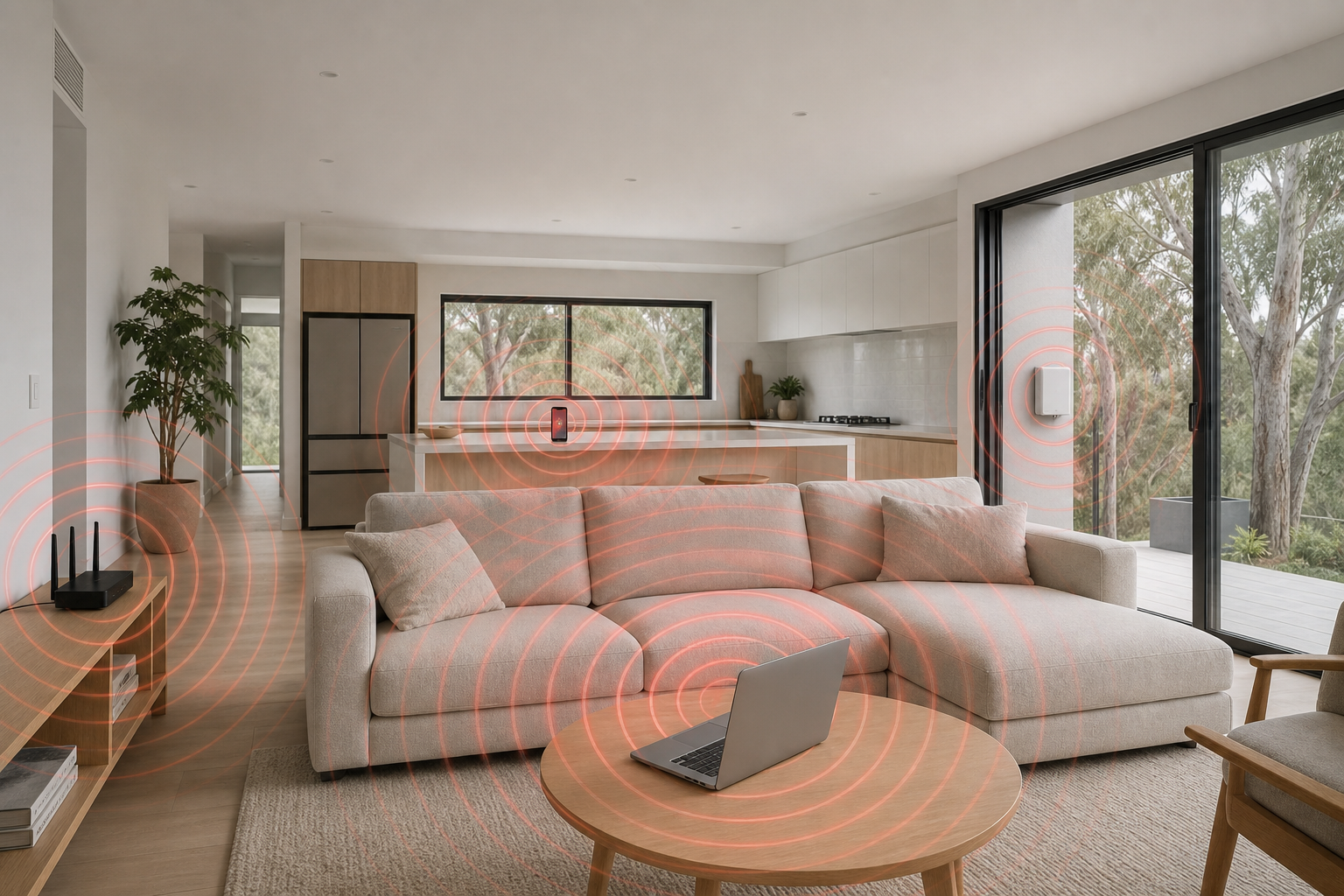
Most Australians assume that if a device is legally sold and approved, it is inherently safe to use for hours on end. We trust that regulators have done the maths and accounted for every variable. When it comes to electromagnetic fields (EMF), the primary framework we rely on is the combination of local and international standards. However, trusting the regulatory thresholds blindly ignores the reality of how modern humans actually live.
At EMF Neutralizer, we have imported and supplied Aulterra products in Australia since 2007. We look past the surface of standard regulatory compliance to the intersection of technology and human biology. Modern connectivity has created an invisible electromagnetic burden that mainstream conversations often ignore. We are constantly bathed in artificial frequencies from smart meters, wireless routers, mobile devices, and household electronics.
To understand the gap, we need to read what the WHO and ARPANSA guidelines on EMF exposure in Australia actually measure, and what they explicitly leave out. Both frameworks are serious and useful for their intended purpose: preventing acute thermal harm from individual sources. Neither was built to assess a modern home or office running many wireless devices at once for most of the day. This article stays at the regulatory level — not a repeat of EMF basics. For what EMF is, how the spectrum works, and how SAR is measured in Australia, use our plain-English EMF radiation explainer first.
Key Takeaways
- ARPANSA EMF standards primarily regulate acute, short-term thermal emissions to prevent immediate tissue heating.
- WHO electromagnetic field safety guidelines do not adequately address the realities of chronic, low-level exposure to multiple devices simultaneously.
- The current regulatory framework measures devices in isolation, completely ignoring the cumulative daily exposure we experience in modern environments.
- Implementing layered EMF protection in your home and office can drastically reduce reported physical symptoms like headaches and persistent fatigue.
- Your home should work with you, not against you. Proactive environmental management is essential for long-term wellbeing.
Protect your family from EMF exposure
Browse our science-backed neutralizer products.
Shop EMF ProtectionSummary Table: Official Guidelines vs. Modern Reality
- Official Regulatory View (ARPANSA & WHO)
- Single device, acute exposure
- Modern Environmental Reality
- Cumulative daily exposure from dozens of sources
- Official Regulatory View (ARPANSA & WHO)
- Immediate tissue heating (thermal effect)
- Modern Environmental Reality
- Chronic load on the nervous system and cellular function
- Official Regulatory View (ARPANSA & WHO)
- Laboratory, isolated conditions
- Modern Environmental Reality
- Real-world homes and high-density offices
- Official Regulatory View (ARPANSA & WHO)
- Short-term calculations
- Modern Environmental Reality
- 16+ hours of continuous daily exposure
- Official Regulatory View (ARPANSA & WHO)
- Compliance with specified absorption rate limits
- Modern Environmental Reality
- Using products that neutralise your environment
Understanding ARPANSA: What the Official Australian Guidelines Actually Measure
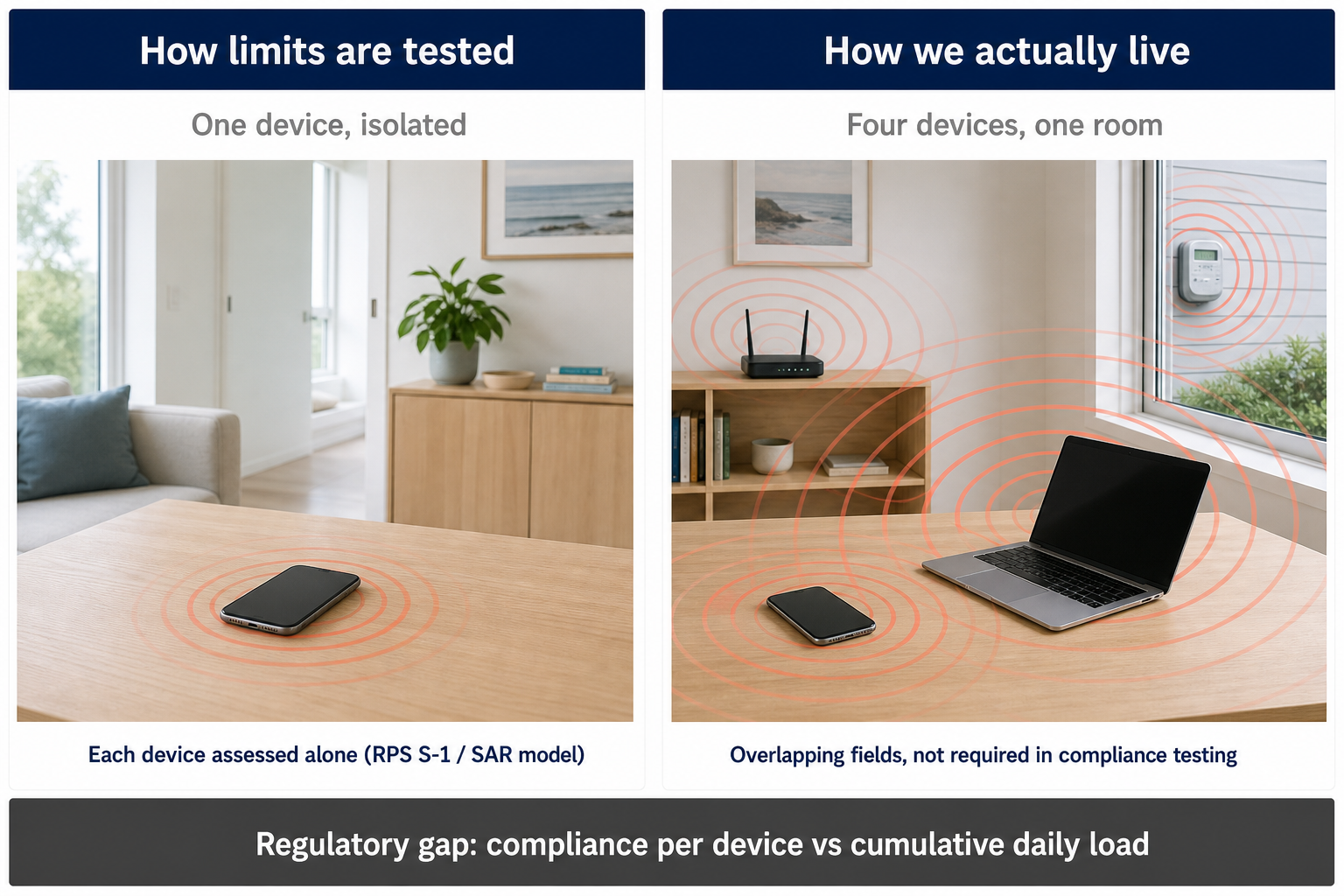
The Australian Radiation Protection and Nuclear Safety Agency (ARPANSA) sets Australia's public exposure limits for radiofrequency and other non-ionising fields. Its primary instrument is the Radiation Protection Standard (RPS S-1), which aligns with ICNIRP reference levels.
For mobile phones, compliance is assessed using Specific Absorption Rate (SAR) — energy absorbed per kilogram of tissue from one device at maximum output in a standardised lab model. How SAR is measured, and why Australia's 2 W/kg limit still reflects single-source testing, is explained in our radiation explainer — regulated thresholds section. ARPANSA's role here is clear: set limits that prevent acute thermal injury from an isolated source. At frequencies above 10 GHz, for example, the standard caps power density at 10 W/m² averaged over 20 minutes.
What RPS S-1 does not require is a whole-room or whole-day model. There is no compliance test for a router, phone, smart meter, Bluetooth headset, and external tower operating together in one living space. Each device is assessed alone. That scope choice is the main regulatory gap this article highlights — not a claim that ARPANSA's physics is wrong, but that its measurement frame does not match how Australians actually use technology.
The WHO Stance: Global Perspectives on Electromagnetic Fields
The World Health Organization (WHO) works in collaboration with the International Commission on Non-Ionizing Radiation Protection (ICNIRP) to establish global frameworks for electromagnetic field safety. WHO electromagnetic field safety guidelines form the bedrock of many national standards, including those in Australia. The WHO-aligned IARC classification places radiofrequency EMF as possibly carcinogenic to humans (Group 2B), based on an increased risk for glioma associated with wireless phone use.
Despite this classification, the official WHO stance maintains that no conclusive evidence confirms adverse health effects from low-level, non-ionising radiation below their thermal guidelines. The organisation acknowledges that some individuals report non-specific symptoms like headaches, fatigue, and sleep disturbances. However, the WHO states that scientific studies have not consistently linked these symptoms to EMF exposure.
The problem with this global perspective, for everyday Australians, is its reliance on population averages and acute exposure metrics. WHO reviews evidence for large, measurable effects. Symptoms that do not show up clearly in broad epidemiology — sleep disruption, fatigue, sensitivity in high-device homes — sit outside what those reviews were designed to resolve. That is a scope limitation, not proof that individual experiences are irrelevant.
For how those day-to-day symptoms are discussed in plain language, see how EMF exposure may show up day to day in our foundation guide.
The Regulatory Gap: What Neither WHO Nor ARPANSA Currently Measures
Here the standard narrative reaches its limit. Public health messaging often implies that if each device meets the thermal guideline, combined use must be fine. That inference is not part of either WHO or ARPANSA documentation. Neither agency publishes a household aggregate exposure standard for simultaneous routers, phones, meters, and wearables over a sixteen-hour day.
At EMF Neutralizer, we treat cumulative daily load — defined in our radiation explainer — as the practical measure that matters once every individual device is legally compliant. For wider Australian context, see our EMF protection in Australia guide and EMF guides index.
Consider a typical home office: laptop, monitor, wireless peripherals, phone on charge, router, smart meter on the external wall. Each item can pass ARPANSA's framework in isolation. No line in RPS S-1 or the WHO thermal guidance requires assessing the overlapping fields you sit in for eight hours. That omission is the regulatory gap — not an argument to ignore standards, but a reason many people take precautionary steps beyond compliance alone.
Beyond Thermal Limits: Why Reported Symptoms Still Matter
Thermal guidelines answer one question: Did this single source heat tissue beyond the limit? They do not answer: What happens when the nervous system runs for months in a high-device environment? Reported sleep disruption, fatigue, and headache patterns in dense digital settings are part of why many customers look beyond compliance — even while each device remains legal.
Low-level, continuous exposure can contribute to a low-grade stress response: sympathetic activation, disrupted melatonin, lighter sleep. We discuss that biology in more detail in the radiation explainer; here the point is simply that WHO and ARPANSA do not use those endpoints when setting current limits.
Among customers who change their environment, we see a consistent qualitative pattern: an estimated 60 to 85 percent reduction in perceived EMF-related fatigue and an estimated 70 to 90 percent reduction in headache frequency in high-device settings. These are aggregate, self-reported descriptions — not clinical trial outcomes — and individual results vary.
Real-World Applications and Measurable Outcomes
Data means nothing without real-world application. Over the years at EMF Neutralizer, I have seen first-hand how addressing cumulative EMF load changes lives. Let us look at a few specific cases that highlight the difference between theoretical regulatory safety and practical, biological wellbeing.
The High-Density Home Office
I worked with an individual who spent long hours at a desk surrounded by technology. He had a laptop, an external monitor, a mobile phone, and various wireless peripherals. This setup is the exact definition of modern productivity, and it is entirely legal under current ARPANSA guidelines. However, he was experiencing persistent headaches and difficulty concentrating throughout the workday. He was hitting a wall of mental fatigue by early afternoon.
We applied Neutralizer Discs directly to each device in the workspace. We addressed the concentrated cluster of electromagnetic field sources that accumulated across his standard eight-hour working day. The change was rapid. His headache frequency dropped by an estimated 70 to 90 percent over a four-week period. He reported markedly improved concentration. Individual results vary, but with reduced ambient electromagnetic stress, his focus improved noticeably.
The Proximity of High-Voltage Infrastructure
I recall a customer who moved into a beautiful new home. Almost immediately, she was plagued with headaches, vertigo, fatigue, and ringing ears. She felt a strange hum in the wall between her and her neighbour. Furthermore, there was a large transformer box right outside her bedroom window. Sleeping in her bedroom felt unsettling and she struggled to rest properly.
The regulatory authorities would argue the transformer box met all safety standards for distance and emissions. Yet, her biology was reacting strongly to the continuous, low-level frequencies penetrating her home. She purchased the Whole House USB and wore an Aulterra energy pendant. After just one night of using the plug-in unit and wearing the pendant, she felt refreshed for the first time in weeks. By applying layered EMF protection, she managed to reclaim her living space. She later ordered stick-on discs for her phone, tablet, smart meter, Wi-Fi router, and solar inverter to further reduce the ambient load. Individual results vary.
Clinical Validation and Blood Analysis
Peter Mitchell is the Principal Physiotherapist and owner of a physiotherapy clinic on the Gold Coast. He was deeply concerned by stress levels due to their use of EMF emitting devices at home and in the office. I suggested he use a house neutralizer at home and in his clinic, along with discs on all his devices.
Peter did not just take my word for it. He conducted his own testing through applied kinesiology. He found the neutraliser products highly effective in reducing the stress levels affected by the radiation coming from mobile devices. He now uses the products on all laptops and mobile phones in his clinic, and he supplies EMF Neutralizers to some of his clients when they ask for them. His clinical observation was clear. The presence of the neutralisers actively mitigated the physiological stress his patients experienced from standard wireless technology.
We also see evidence in live blood analysis. Customer Devin filmed a dark field microscopy test: after four minutes near an operating microwave, her blood showed notable clumping; with an Aulterra pendant, clumping was markedly reduced. That is one self-funded independent observation, not a clinical trial, and individual results vary. For more on how we discuss testing and research, see independent scientific studies on EMF neutralisation and our science and evidence page.
Practical Steps to Reduce Cumulative EMF Load in Australia
Understanding the limitations of the WHO and ARPANSA guidelines on EMF exposure in Australia is only the first step. You must take proactive measures to reduce the environmental burden in your daily life.
First, distance is your most basic defence. Electromagnetic field strength drops off significantly as you move away from the source. Never keep your mobile phone directly against your body for extended periods. Do not place a Wi-Fi router in a high-traffic living area or directly adjacent to a bedroom wall. Keep clocks and smart devices at least two metres away from your head while you sleep.
Second, hardwire your internet where possible. Running ethernet cables to your computers and laptops eliminates the constant microwave radiation emitted by Wi-Fi. If you must use Wi-Fi, turn the router off at night to give your nervous system an eight-hour break from the continuous signal.
Third, address the cumulative daily exposure by implementing active neutralisation technology. As demonstrated in our customer reports and practitioner observations, applying targeted products to high-emission devices like laptops and phones can reduce the biological stress load. Browse our products or read common questions in our EMF protection FAQs.
Finally, protect your sleep environment. The bedroom is where your body performs its most critical cellular repair. Remove all unnecessary electronics. Ensure your bed is not positioned directly against a wall housing a smart meter or a refrigerator. When you make these deliberate choices, you ensure that your home should work with you, not against you. You build an environment that fosters health, focus, and genuine rest.
References
- ARPANSA, Radiation Protection Standard for Maximum Exposure Levels to Radiofrequency Fields - 3 kHz to 300 GHz (RPS S-1).
- WHO, Radiation and health: wireless technologies.
- ICNIRP, Guidelines for limiting exposure to electromagnetic fields (100 kHz to 300 GHz).
- WHO, The International EMF Project.
Stay informed on EMF wellness
Get practical tips and product updates in your inbox.
Frequently asked questions
Does our "who and arpansa guidelines on emf exposure in australia" guide explain that ARPANSA standards are not sufficient for modern environments?
Yes. This guide explains that ARPANSA EMF standards are designed to prevent acute thermal injuries from single devices. They are highly effective at ensuring a mobile phone does not burn your tissue. However, they are insufficient for modern environments because they do not account for the cumulative daily exposure of dozens of wireless devices operating simultaneously in a confined space.
Does the WHO recognise electromagnetic hypersensitivity?
The WHO acknowledges that some individuals report symptoms like headaches and fatigue related to EMF exposure. However, it does not classify electromagnetic hypersensitivity as a distinct medical diagnosis, largely because broad epidemiological studies focus on acute thermal data rather than subtle, chronic biological stress.
What is cumulative EMF load?
Cumulative EMF load is the combined electromagnetic output of multiple devices in one environment: router, smart meter, laptop, phone, and more operating together. We define it in our EMF radiation explainer. WHO and ARPANSA guidelines do not model that aggregate scenario when setting single-device limits.
How does cumulative daily exposure affect sleep?
Chronic exposure to low-level artificial frequencies triggers a low-grade stress response in the body. This can disrupt the production of melatonin, the hormone responsible for regulating sleep cycles, keeping the nervous system in a state of hyperarousal and preventing deep, restorative sleep.
Do EMF Neutralizer products actually reduce fatigue?
Based on extensive qualitative customer feedback, users who actively neutralise their environment often report an estimated 60 to 85 percent reduction in perceived EMF-related fatigue. These are self-reported, qualitative outcome descriptions, not clinical trial results, and individual results vary.
How can I test the effectiveness of EMF protection?
Some customers and practitioners use methods such as live blood analysis with dark field microscopy or applied kinesiology testing. As shown on our testimonials page, live blood analysis has documented less cellular clumping when neutralising products are used during EMF exposure in independent customer observations, not controlled clinical trials.
Can layered EMF protection reduce headaches?
In high-device environments, customers who implement layered EMF protection often report an estimated 70 to 90 percent reduction in headache frequency. These figures come from qualitative, customer-reported outcome descriptions, not clinical measurements, and individual results vary.
Where should I start to reduce my household EMF burden?
Start by hardwiring your internet connections, keeping devices away from your body, and removing electronics from the bedroom. Next, apply neutralising products to your most frequently used devices, such as your mobile phone and laptop, and install a whole-house unit to address external ambient frequencies.
Richard Kent
Science-backed EMF wellness education from the EMF Neutralizer team.
Related articles
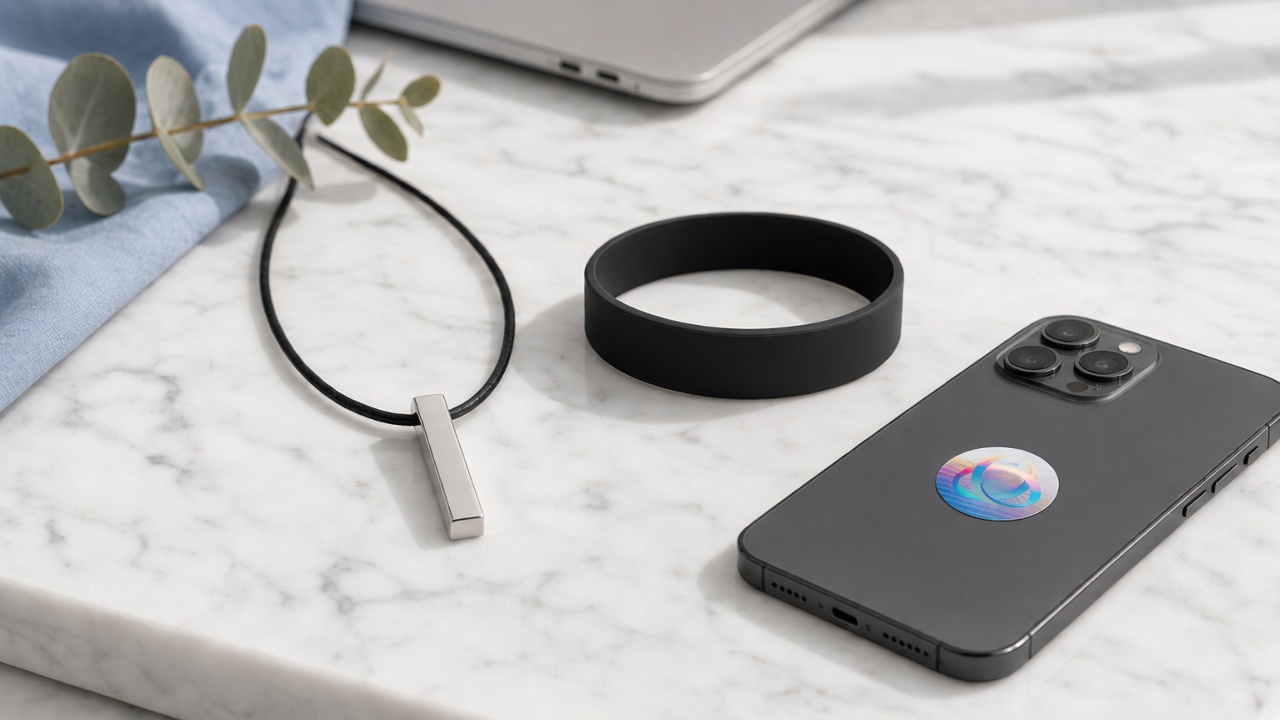
Best EMF Protection Jewellery Australia: A Guide to the Aulterra Range
The best EMF protection jewellery in Australia is the Aulterra range: three pendant designs and the Vitality Wristband, worn continuously to neutralise disrupti…

EMF protection pendant buying guide for Australians
An EMF protection pendant should be assessed by its stated purpose, evidence, seller transparency, construction, coverage and returns policy. Choose a pendant d…

Independent Scientific Studies EMF Neutralisation: What the Research Actually Shows (2026)
If you have spent any time researching EMF protection, you have probably encountered two very different conversations. On one side, mainstream health agencies l…