EMF and pregnancy risks
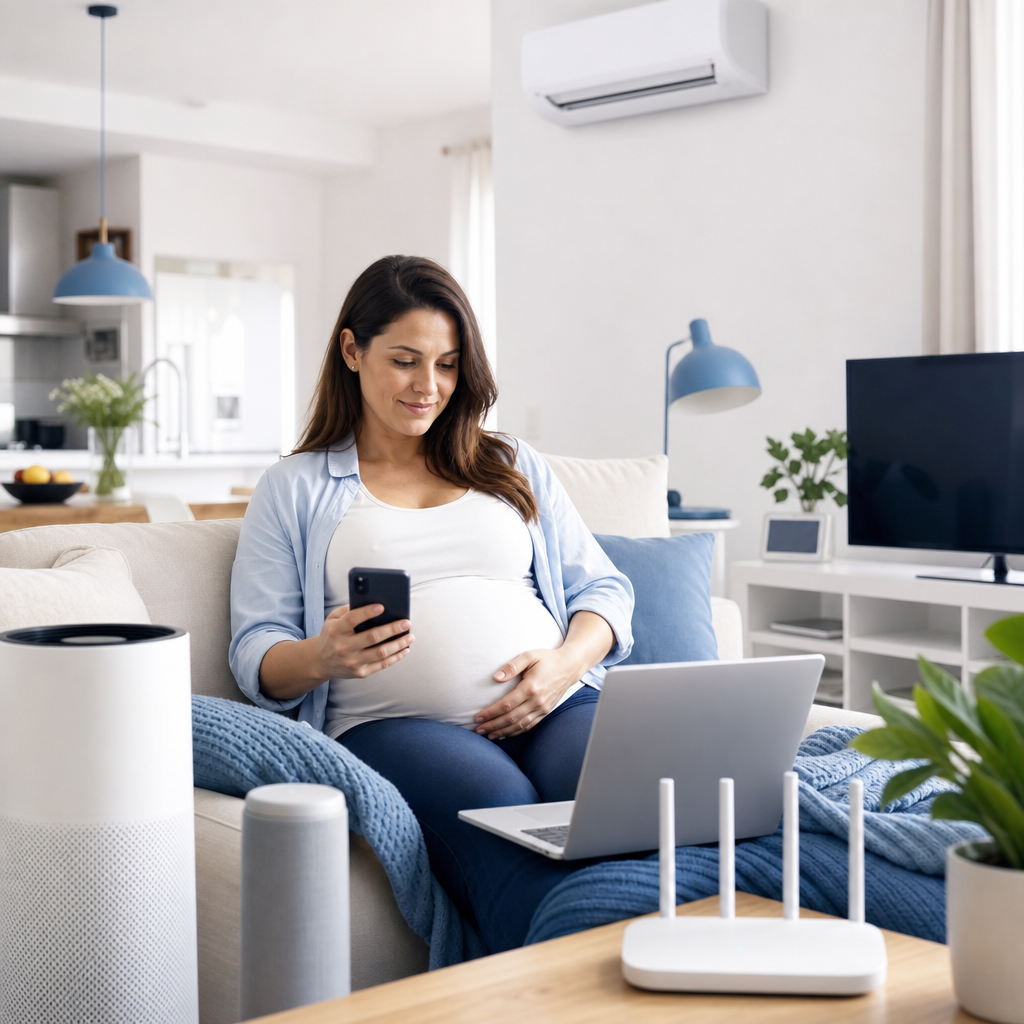
EMF and pregnancy risks remain uncertain at normal household exposure levels. Australian and international regulators have not established that compliant everyday exposure harms pregnancy. The sections below explain what that means in practice — and how to respond without compromising medical care, communication or personal safety.
Pregnancy often changes how you assess environmental risks. Devices that once seemed routine can feel different when a mobile, laptop, router and smart meter contribute to an invisible electromagnetic burden around your home.
The evidence requires perspective. For EMF basics, see our plain-English radiation explainer. For wider context on EMF and health, see our EMF health concerns hub. For product choices by setting, see our EMF protection guide. This guide explains what exposure limits cover, where uncertainty remains and how to reduce cumulative daily exposure without fear-based decisions. Couples planning pregnancy may also want our EMF and fertility guide.
Key takeaways
The practical response is neither panic nor dismissal. Neutralise your main devices and sources, and add distance where it is easy — especially in the bedroom and around your abdomen — while preserving access to communication and healthcare.
- Everyday phones, Wi-Fi, Bluetooth devices, appliances and electrical wiring produce non-ionising electromagnetic fields.
- Australian public exposure limits are designed to protect the general population, including pregnant people.
- Research on pregnancy outcomes is difficult to interpret because exposure measurement and confounding factors vary considerably.
- Distance from a source is a simple, no-cost way to add caution during pregnancy — particularly overnight and for devices held against the body.
- A balanced approach combines neutralisation of main sources with sensible distance habits where practical.
- EMF neutralisers should support cautious pregnancy habits, not replace medical advice or established safety measures.
Protect your family from EMF exposure
Browse our science-backed neutralizer products.
Shop EMF ProtectionSummary table
Different sources require different responses. A mobile close to the body creates a different exposure pattern from a router across a room or electrical wiring inside a wall. This table separates the main source categories, typical pregnancy considerations and the most practical actions available in an Australian home.
- Field type
- Radiofrequency and low-frequency fields
- Main consideration
- Close body contact and changing transmit power
- Practical response
- Use speakerphone and keep the phone away from the abdomen
- Field type
- Radiofrequency
- Main consideration
- Continuous background transmission and proximity
- Practical response
- Position it away from beds and prolonged sitting areas
- Field type
- Radiofrequency plus fields from electronics and chargers
- Main consideration
- Direct contact when used on the lap
- Practical response
- Use a desk or firm surface and create distance from the body
- Field type
- Extremely low-frequency fields
- Main consideration
- Stronger fields can occur close to motors, transformers and wiring
- Practical response
- Increase distance and investigate unusual hotspots
- Field type
- Radiofrequency
- Main consideration
- Intermittent transmission and location relative to living spaces
- Practical response
- Avoid placing beds or desks directly beside the meter wall where practical
- Field type
- Depends on the procedure
- Main consideration
- Clinical benefit, field type and pregnancy-specific protocols
- Practical response
- Tell the practitioner you are pregnant and follow clinical advice
What does EMF exposure mean during pregnancy?
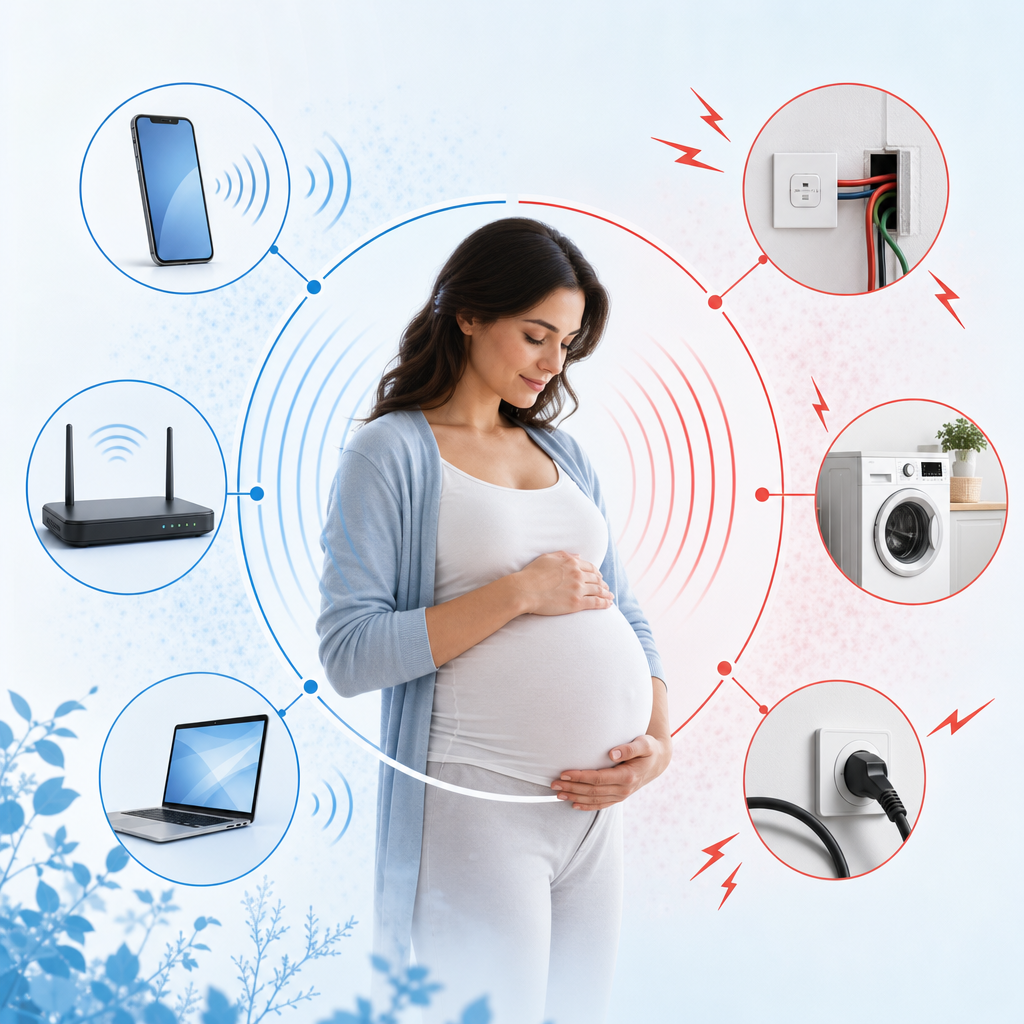
EMF exposure during pregnancy means the pregnant person and developing baby are within electric, magnetic or radiofrequency fields produced by natural and human-made sources. The relevant questions are the field type, strength, distance, duration and transmission pattern. Grouping every source under the term "radiation" creates unnecessary confusion.
Electromagnetic fields are not a single exposure category. The main household categories are radiofrequency fields and extremely low-frequency fields.
Radiofrequency fields come from mobile phones, mobile towers, Wi-Fi routers, Bluetooth accessories, cordless phones and smart meters. Extremely low-frequency fields arise around electrical wiring, power supplies, motors, induction systems and household appliances.
These are forms of non-ionising radiation. They do not carry enough energy to ionise atoms in the way that X-rays and gamma rays can. That distinction matters, but "non-ionising" should not be interpreted as meaning that no biological interaction is possible under any conditions.
At sufficiently high radiofrequency exposure, established effects include tissue heating. Australian limits are designed to prevent harmful exposure based on recognised interaction mechanisms. The ARPANSA Standard for Limiting Exposure to Radiofrequency Fields provides the relevant Australian framework.
Exposure is also highly dependent on proximity. A phone transmitting against the body is a different scenario from the same phone sitting across a room. A router beside a bed is different from one positioned in a less occupied part of the home.
This is why a useful home assessment looks at where devices are located and how they are used. A list of devices alone does not reveal your actual exposure pattern.
What does the evidence say about EMF and pregnancy risks?
Current evidence has not established that everyday EMF exposure below recognised public limits causes miscarriage, congenital conditions, premature birth or impaired childhood development. However, pregnancy research contains important limitations. Many studies estimate exposure indirectly, rely on self-reported device use or cannot fully separate EMF from sleep, stress and lifestyle factors.
The World Health Organization states that research has not confirmed adverse health consequences from low-level electromagnetic field exposure. Its position should be read accurately. It does not mean that every possible effect has been disproved. It means a causal adverse effect has not been established from the evidence assessed.
The WHO overview of wireless technologies and health also explains the established heating mechanism and the role of exposure guidelines.
Pregnancy studies are particularly challenging for several reasons:
- Phone ownership does not show how close the phone was to the body.
- Screen time is not the same as radiofrequency exposure.
- A weak mobile signal can change how a phone transmits.
- Device use can correlate with sleep disruption, sedentary behaviour and stress.
- Residential proximity to infrastructure does not necessarily measure personal exposure.
- Different pregnancy stages may involve different biological considerations.
These factors can produce associations without proving that EMF caused the outcome. They can also obscure an effect if exposure is classified poorly.
This uncertainty supports a measured position. Do not treat normal household exposure as a proven cause of pregnancy complications. During pregnancy, it is still sensible to be cautiously practical: avoid resting transmitting devices directly against your abdomen when a simple alternative exists, and keep sleeping areas as low-field as practical.
If you experience bleeding, severe headache, fainting, reduced foetal movement, persistent pain or another concerning symptom, contact your maternity care provider. Do not attribute symptoms to EMF and delay an appropriate clinical assessment.
Do Australian exposure limits protect pregnant people?
Australian radiofrequency exposure limits apply to the general public, including pregnant people and children. They are intended to prevent established adverse effects and incorporate safety margins. Pregnancy does not have a separate lower public limit. Compliance, however, answers a regulatory question and does not describe every person's cumulative daily exposure pattern. For how WHO and ARPANSA guidelines relate to multi-device homes, see our dedicated explainer.
Australia's framework is informed by the International Commission on Non-Ionizing Radiation Protection guidelines. The ICNIRP radiofrequency guidelines published in 2020 address whole-body and local exposure across relevant frequencies.
Exposure limits matter because they provide a defined safety framework grounded in established science. They are considerably more useful than vague claims that any detectable field is inherently dangerous.
However, limits should not be mistaken for a personalised wellbeing assessment. A compliant router, phone, smart meter and laptop can still create an environment containing several simultaneous sources. Standards include methods for assessing combined exposure where relevant, but most households are not conducting a detailed personal exposure assessment across an entire day.
That distinction shapes our position at EMF Neutralizer. We accept the importance of regulated thresholds, while also believing that the aggregate environment deserves attention. The question is not only whether each device complies. It is also whether its location and use create avoidable close-range exposure.
ARPANSA provides Australian guidance on mobile phones and health and Wi-Fi and health. These resources are appropriate starting points for the mainstream regulatory position.
What do mobile phone manuals say about body contact?
Mobile phone manuals and in-device legal pages include radiofrequency safety information that many people never open. This is usually SAR compliance language, not a pregnancy diagnosis or a ban on normal phone use.
In Australia, mobile phones must comply with a Specific Absorption Rate (SAR) limit of 2 W/kg averaged over 10 grams of tissue. Body-worn SAR testing is performed at a minimum separation from the body — commonly about 5 mm on many iPhones, 1.5 cm on many Samsung models, or a similar distance on other brands. The manual then tells you to keep the device at least that far from your body during body-worn use so real-world use matches the tested configuration. Many manuals also recommend hands-free options such as speakerphone for calls.
Carrying an actively transmitting phone in a pocket against the abdomen, or resting it there, is outside that tested setup. Regulators have not established that everyday compliant use harms pregnancy, and Australian limits apply to the general population including pregnant people. The manual language nevertheless explains why distance from the body is a reasonable precaution during pregnancy. Some consumer advisories in certain markets also recommend keeping phones away from a pregnant person's abdomen; that is separate guidance, not the same as the universal SAR separation text in your device's RF Exposure or Safety information.
To read your own phone's wording: on iPhone, open Settings → General → Legal & Regulatory → RF Exposure; on many Android models, open About phone → Legal information or Safety information. For how SAR is measured in Australia, see our radiation explainer.
How can you reduce EMF exposure during pregnancy?
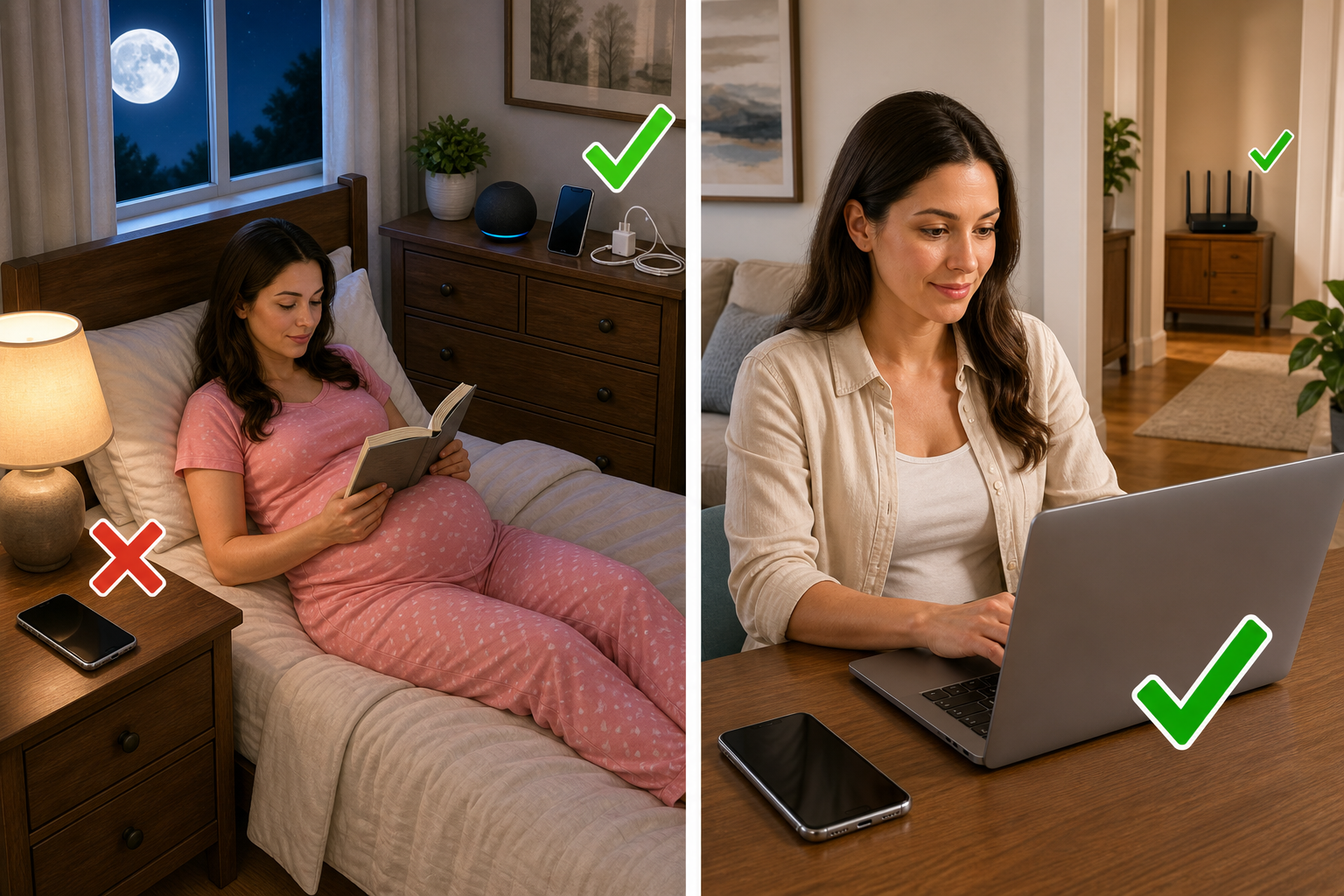
During pregnancy, reduce avoidable close-range exposure through neutralisation and sensible distance together. Neutralise phones, laptops, routers and other main sources first — that is what allows normal daily use without constant rearrangement. Add distance where it is practical: your sleeping area, workstation and anywhere you would otherwise carry a phone against your abdomen. The manual separation guidance above is one reason that distance matters. These steps are inexpensive and do not require abandoning useful technology. See our guides on EMF from a phone while sleeping and bedroom EMF reduction for overnight sources.
Keep transmitting phones away from the abdomen
Avoid carrying an active phone directly against your abdomen when practical. Place it in a bag or on a nearby surface. Speakerphone works well for longer calls while keeping the phone away from your body.
A phone can continue exchanging signals when the screen is off. Airplane mode can reduce transmissions, but Wi-Fi or Bluetooth may remain available if manually reactivated. Check the device settings rather than relying on the airplane symbol alone.
Do not compromise access to emergency calls or essential maternity communication. Exposure reduction should support your wellbeing, not create a new safety problem.
Use laptops and tablets on a surface
A laptop is better placed on a desk than directly on your lap or abdomen. This creates distance from its internal electronics, wireless antennas and power supply.
Chargers and power bricks can also produce local fields. Keep them away from the body where practical. This advice is simple source management, not evidence that occasional lap use causes pregnancy harm.
Review the sleeping environment
Sleep is a long, repeated period in one location. Move phones, wireless chargers, routers and powered devices away from the bedside where possible. If you need your mobile for alarms or emergency contact, place it farther from your head rather than removing it completely. For wider sleep context, see EMF and sleep disruption.
Check the other side of the bedroom wall. A meter box, router, television, refrigerator or electrical equipment in an adjoining room can be closer than it appears.
Improve router placement
A router does not need to sit beside a bed, cot, sofa or home-office chair. Position it where it can provide reliable coverage without being immediately beside a place occupied for prolonged periods.
Turning Wi-Fi off overnight is an optional exposure-reduction measure, not a medical requirement. It may be unsuitable if your home uses connected medical, security or communication systems.
Avoid questionable shielding
Poorly selected shielding can create unintended results. Partially obstructing a mobile signal may cause the phone to alter its transmit power while trying to maintain a connection. Shielding materials can also redirect fields rather than removing them.
Any shielding plan should be based on measurements before and after installation. A product that merely blocks a consumer meter from one direction does not prove that the occupied area has improved.
Measure the right field
Consumer meters are useful for identifying sources, but they have limitations. A radiofrequency meter does not necessarily measure low-frequency magnetic fields, and a basic magnetic-field meter does not characterise mobile or Wi-Fi exposure. Our home EMF testing guide walks through meter types and what each can and cannot show.
Record measurements by location and operating condition. Compare a device when idle, transmitting, charging and disconnected. The goal is to identify controllable sources, not to chase every fluctuating reading.
Our view: compliance is the floor, not the complete household plan
Our position is that source-by-source compliance does not fully describe the lived environment. Pregnancy can involve prolonged time at home, disrupted sleep and repeated close contact with technology. A useful plan therefore combines neutralisation of your main devices with thoughtful caution — distance where it is easy, especially overnight — while remaining honest about what science has and has not proved.
This is where our view differs from the common advice to ignore any source below the public limit. Your home should work with you, not against you. Neutralise the devices you live with daily, and move routers or phones farther from the bed when you can do so without disrupting function.
We also reject fear-based selling. A reading on a meter is not a diagnosis. A headache is not proof of EMF injury. Pregnancy complications require qualified medical care. Products should never be marketed as treatments for miscarriage risk, foetal conditions or other medical outcomes without appropriate clinical evidence.
Our first-hand customer experience does suggest that environments containing many close devices deserve more attention. An individual working at a desk with a laptop, external monitor, mobile and wireless peripherals reported persistent headaches and poor concentration. After neutralising the device cluster, they reported an estimated 70–90% reduction in headache frequency over four weeks, based on qualitative feedback to EMF Neutralizer. Individual results vary.
That result is not pregnancy evidence, a controlled trial or proof of causation. It is useful for a different reason. The case shows why changing an entire source cluster may be more informative than focusing on a single device. It also shows the importance of recording symptoms over time rather than relying on an immediate impression.
For pregnancy, we recommend neutralising your main devices and sources first. That is what makes normal phone, laptop and router use workable without constant avoidance. Pregnancy is still a sensible time for extra caution where it costs little: keep phones and routers farther from the bed overnight, avoid resting transmitting devices directly on your abdomen when a desk or bag works just as well, and add distance in any space where you spend long hours. Neutralised fields are intended to be lived with comfortably; cautious habits and neutralisation support each other. Browse the EMF protection hub or read how Aulterra neutralisation works before choosing products.
If you want help identifying the main sources in your home and choosing a proportionate approach, use the EMF Neutralizer contact page. Explain your room layout, devices and concerns so the advice can focus on your actual environment.
When should you get professional or medical advice?
Speak with your maternity care provider before changing medical care, avoiding clinically recommended imaging or attributing pregnancy symptoms to EMF. Consult an appropriately trained exposure assessor when you have a persistent hotspot, nearby electrical infrastructure, unusual wiring concerns or measurements you cannot interpret confidently. Different problems require different expertise.
Medical imaging should be assessed through clinical benefit and risk, not grouped casually with phones or Wi-Fi. Tell the radiology or maternity team that you are pregnant or may be pregnant. They can select the appropriate procedure and precautions.
An electrician is the right professional for suspected wiring faults, earthing concerns, damaged equipment or unusual electrical behaviour. An EMF assessor may help map radiofrequency and low-frequency fields, but measurement methods and equipment quality vary. Ask what instruments will be used and which field types they measure.
Be cautious if anyone:
- diagnoses illness solely from an EMF meter reading
- promises to prevent pregnancy complications
- recommends abandoning prescribed care
- cannot explain what field type is being measured
- sells a universal solution without asking about distance, layout or device use
Practical control starts with accurate source identification. Good advice should reduce uncertainty, not amplify anxiety.
References
These sources establish the regulatory and public-health context used in this guide. They do not endorse EMF Neutralizer products. Readers should use them alongside advice from their maternity care provider, particularly when making decisions about symptoms, medical imaging or clinically recommended treatment.
- Australian Radiation Protection and Nuclear Safety Agency, Standard for Limiting Exposure to Radiofrequency Fields.
- Australian Radiation Protection and Nuclear Safety Agency, Mobile phones and health.
- Australian Radiation Protection and Nuclear Safety Agency, Wi-Fi and health.
- International Commission on Non-Ionizing Radiation Protection, Guidelines for Limiting Exposure to Electromagnetic Fields, published in 2020.
- World Health Organization, Radiation and health: wireless technologies.
Stay informed on EMF wellness
Get practical tips and product updates in your inbox.
Frequently asked questions
Does our "emf and pregnancy risks" guide explain what the evidence does and does not show?
Yes. This guide explains that current evidence has not established harm from everyday EMF below recognised public limits, while outlining where pregnancy research remains limited and how to reduce avoidable close-range exposure at home.
Can Wi-Fi harm an unborn baby?
Regulators do not consider compliant everyday Wi-Fi a pregnancy risk, and current evidence has not established harm below recognised public limits. Wi-Fi comes from routers and from phones, laptops and other connected devices — so reduce avoidable close-range exposure by keeping those sources away from your abdomen, bed and prolonged sitting areas.
Do EMF exposure limits include pregnant people?
Yes. Australian public radiofrequency limits apply to the general population, including pregnant people. There is no separate lower public limit for pregnancy.
Should I turn Wi-Fi off at night while pregnant?
You do not need to turn Wi-Fi off at night during pregnancy — regulators do not identify it as a requirement. If you want to reduce overnight exposure, moving phones, wireless chargers and the router away from the bed usually matters most. A simple mains timer on the router ($15–30) is an optional extra step many households use; skip it if your home relies on connected medical, security or communication systems overnight.
Is it safe to use a laptop on my bump?
Normal laptop use has not been established as a cause of pregnancy harm, but placing the device on a desk is a sensible precautionary step that reduces direct contact with heat, electronics, wireless antennas and the charger.
During pregnancy, can I use phones and laptops normally if my devices are neutralised?
Yes — that is the practical purpose of Aulterra neutralisation. Applied to phones, laptops, routers and other sources, neutralisers retune incoherent fields so everyday device use does not require constant avoidance or rearrangement. Pregnancy is still a sensible time to be thoughtfully cautious: keep extra distance where it is easy — especially overnight in the bedroom, and avoid resting transmitting devices directly against your abdomen when a simple alternative exists. Neutralised fields are intended to be lived with comfortably; cautious habits and neutralisation work together rather than replacing each other. Neutralisers do not block signals. Persistent pregnancy symptoms should be assessed by your maternity care provider, not assumed to be EMF-related.
Can EMF exposure explain headaches or fatigue during pregnancy?
Headaches and fatigue have many possible causes during pregnancy. EMF should not be assumed to be the cause. Persistent, severe or unusual symptoms require advice from a maternity care provider.
What do mobile phone manuals mean by keeping the phone away from your body?
They document SAR compliance, not a pregnancy diagnosis. Manufacturers test phones at a minimum separation from the body — often about 5 mm to 1.5 cm or more, depending on the model — and instruct users to maintain that distance so use matches the tested configuration. Many also recommend speakerphone or hands-free calling. During pregnancy, that supports practical habits such as keeping an active phone off the abdomen; it does not mean everyday compliant use has been proved harmful.
Are EMF protection products TGA approved?
EMF protection products including neutraliser discs and whole-house USB devices are not medical devices and are not subject to TGA (Therapeutic Goods Administration) regulation in Australia. The TGA regulates products intended to diagnose, prevent, or treat medical conditions. EMF neutralisation products are environmental wellness products designed to modify the electromagnetic field properties of emission sources. They are not presented as treatments for pregnancy complications or any medical condition. Pregnancy symptoms, foetal health concerns and clinical decisions should be assessed and managed by your maternity care provider.

Richard Kent
Science-backed EMF wellness education from the EMF Neutralizer team.
Related articles
5G Health Concerns Australia
Australian health authorities say 5G radiofrequency exposure below national limits has not been shown to cause adverse health effects. However, that does not ma…
Recognising the Signs: A Guide to EMF Exposure Symptoms Australia
Reported EMF exposure symptoms include headaches, fatigue, sleep disturbance, poor concentration, dizziness, tinnitus and skin discomfort. These symptoms are re…

EMF and Male Fertility: How Exposure May Affect Sperm Health
EMF exposure may affect male fertility by influencing sperm motility, viability, oxidative balance and testicular temperature. Laboratory findings justify pract…